

























Frequently asked questions
What routes and tasks suit helicopters?
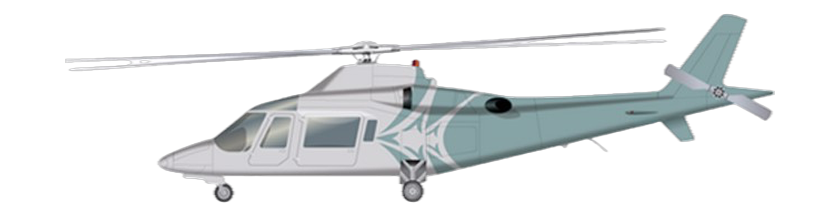
A helicopter solves 'last-mile' and short-leg tasks up to 400–800 km: an airport–residence transfer in 15 minutes instead of two hours of traffic, site surveys, ski resorts, hunting and fishing, and delivery to a yacht. Landing is possible on a 25×25 m pad — a business-centre roof, a hotel grounds, a deck. Time savings on short distances reach 80% versus a car. Send us a request — we'll prepare options, calculate running costs and analyse the best fit for your task.
What range and how many passengers do helicopters have?
Light piston and turbine machines (R44, R66, Bell 505, H125) take 3–5 passengers over 400–650 km. Light twins (AW109, Bell 429, H145) — 6–8 seats and 600–850 km. Medium (AW139, H175, Mi-8) — 9–15 seats in VIP and 1,000+ km. Cruise speeds are 220–310 km/h. Baggage is limited: usually a bag per passenger. Send us a request — we'll prepare options, calculate running costs and analyse the best fit for your task.
How does a helicopter differ from neighbouring classes?
Twins (AW109, H135, Bell 429) keep flying if one engine fails, so they are cleared over dense urban areas and water — for regular corporate programmes in a metropolis this is often mandatory. Singles (H125, R66, Bell 505) are 30–50% cheaper to buy and own. In practice: city and offshore — a twin; regions and private flights — a single. Send us a request — we'll prepare options, calculate running costs and analyse the best fit for your task.
Which helicopters are in the fleet and how do they differ?
21 models — from the Robinson R44/R66 for private flights to heavy helicopters: the full Airbus H125–H175 line (including the newest H160), Italian Leonardo AW109/AW139/AW169/AW189 with VIP cabins, American Bell 505/407GXi/429/525, plus the Ansat and Mi-8AMT supported in the CIS and seating up to 22. Selection follows the task: city, mountains, offshore or a large group. Send us a request — we'll prepare options, calculate running costs and analyse the best fit for your task.
How do you choose an aircraft to buy for your needs?
Start from two numbers: the length of your typical route and the number of passengers. Up to 1,000 km and 4 people — a turboprop or light jet; 2,000–4,000 km — a midsize jet; nonstop intercontinental — a long-range jet. Then adjust for short runways, baggage volume and sleeping berths. We'll match a model to your profile and calculate the ownership economics. Send us a request — we'll prepare options, calculate running costs and analyse the best fit for your task.
New aircraft or pre-owned — which is the better buy?
A new aircraft means a factory warranty and a 1–3-year queue, but the price is at its peak. A pre-owned aircraft means immediate delivery and a price 30–60% lower, while engine time and history matter. For most buyers a fresh 3–7-year-old aircraft is optimal: the main depreciation has happened and plenty of life remains. We cost both options. Send us a request — we'll prepare options, calculate running costs and analyse the best fit for your task.
Which aircraft class should you choose for your routes and passengers?
Turboprops — up to 1,500 km, 4–9 seats; light jets — up to 4,000 km; midsize — a stand-up cabin and 4–6 hours; super-midsize and large — 6,300–7,400 km, 8–12 people; long-range — up to 14,800 km nonstop. Helicopters cover door-to-door legs up to 800 km. We'll match the class to your task. Send us a request — we'll prepare options, calculate running costs and analyse the best fit for your task.
How much does it cost to own an aircraft per year?
The bulk of costs are fixed — hangar, crew, maintenance, insurance — and independent of hours flown. At 300–400 h/year a guide: turboprop $0.6–0.9M, light jet ~$1.6M, midsize $2–2.4M, large $2.8–3M, long-range $3.8–4.7M. We calculate the exact figure for a specific model and your hours. Send us a request — we'll prepare options, calculate running costs and analyse the best fit for your task.
What drives the cost of a flight hour when you own an aircraft?
Three cost groups: direct (fuel, hourly reserves for engines and airframe), crew (salaries, training, hotels) and fixed (insurance, hangar, management), spread across hours flown. The more you fly, the lower the hour. A guide at 400 h/year runs from $1,500 on a turboprop to $10,000+ on a long-range jet. Send us a request — we'll prepare options, calculate running costs and analyse the best fit for your task.
How well does an aircraft hold its value and what matters for resale?
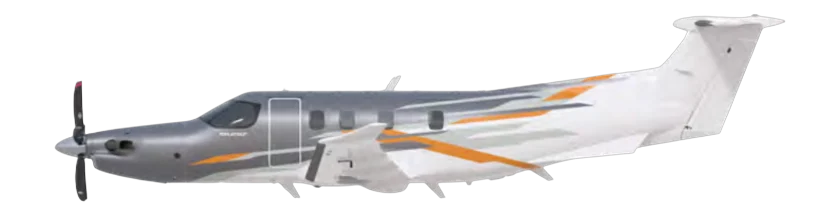
Liquidity depends on the model, fleet size, engine time and interior freshness. High-volume models (Phenom 300, Challenger 650, PC-12, G650ER) hold value better and sell in 60–120 days. When buying, look at residual value and demand — it protects your investment. We'll advise which models are most liquid in your budget. Send us a request — we'll prepare options, calculate running costs and analyse the best fit for your task.


 VTOL">

