





Frequently asked questions
Sukhoi Business Jet: what kind of aircraft is it and what to consider when buying?
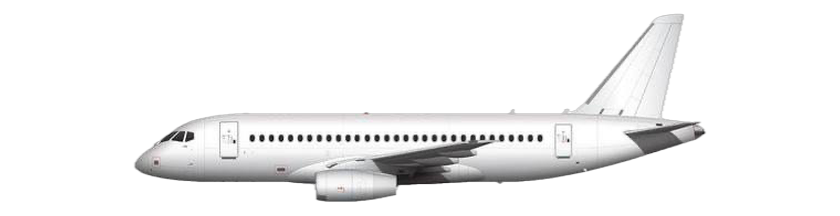
The SBJ is the business version of the Superjet 100, built since 2014: a cabin of about 60 m² for 19–23 seats with a bedroom and meeting room, a range of up to 7,200 km with extra tanks (over 7,200 km nonstop) and SaM146 engines. The only business liner with a full production and support cycle in Russia — a sanctions-resilient solution for the CIS market. The cabin has a flight attendant and hot meal service. The baggage compartment is accessible in flight. On typical legs it covers routes such as Paris–Geneva · Paris–Lisbon · Geneva–Dubai. Send us a request — we'll prepare options, calculate running costs and analyse the best fit for your task.
How much does the Sukhoi Business Jet cost: purchase and running costs?
Guide figures for the Sukhoi Business Jet: average pre-owned price — $30M; new — $45M. Running costs at 300–400 h/year — about $4.23M/year, or $10,578 per flight hour. The final figure depends on year, hours flown, engine-programme status and configuration. Send us a request — we'll prepare options, calculate running costs and analyse the best fit for your task.
What is the Sukhoi Business Jet and why is it interesting?
The SBJ is the business version of the Superjet 100 regional airliner: a ~60 m² cabin for 19–23 seats with a bedroom, meeting room and full-size galley. With extra tanks its range reaches ~7,200 km — over 7,200 km nonstop. In essence it is the ACJ/BBJ business-liner class, but at the ownership cost of a regional aircraft. Send us a request — we'll prepare options, calculate running costs and analyse the best fit for your task.
How does the SBJ compare in price with the ACJ and BBJ?
A VIP-configured SBJ runs $35–50M versus $90–130M for a new ACJ TwoTwenty or BBJ 737 MAX — a two-to-three-fold difference for comparable cabin area. The operating hour is also markedly cheaper thanks to lower fuel burn and available technical support. The trade-off is shorter range and a young service network outside the CIS. Send us a request — we'll prepare options, calculate running costs and analyse the best fit for your task.
For whom is the SBJ a rational choice?
For companies and families flying in groups of 10–20 within the CIS, to Asia and the Middle East: delegations, principal transport, sports teams. On such tasks the SBJ replaces two large business jets, and service in Russia and Kazakhstan removes dependence on foreign centres. For regular nonstop flights to the Americas the class is no longer enough — that calls for a BBJ/ACJ or a Global. Send us a request — we'll prepare options, calculate running costs and analyse the best fit for your task.
Which country is Sukhoi from, how old is the marque and how many business liners built?
Sukhoi is a Russian design bureau founded in 1939. The SBJ business version is built on the Superjet 100 regional airliner (about 230 of the family built). It is the only business liner with a full production and support cycle in Russia. Send us a request — we'll prepare options, calculate running costs and analyse the best fit for your task.
What routes and tasks suit business liners?
A business liner is a flying residence or headquarters: cabins of 60–270 m² hold bedrooms, showers, meeting rooms for 8–12 and a staff area. Typical scenarios: flights for heads of state and corporations with 15–50-person delegations, family travel with staff, and artist and sports-team tours. Where a group feels cramped even in a Global, liner territory begins. Send us a request — we'll prepare options, calculate running costs and analyse the best fit for your task.
What range and how many passengers do business liners have?
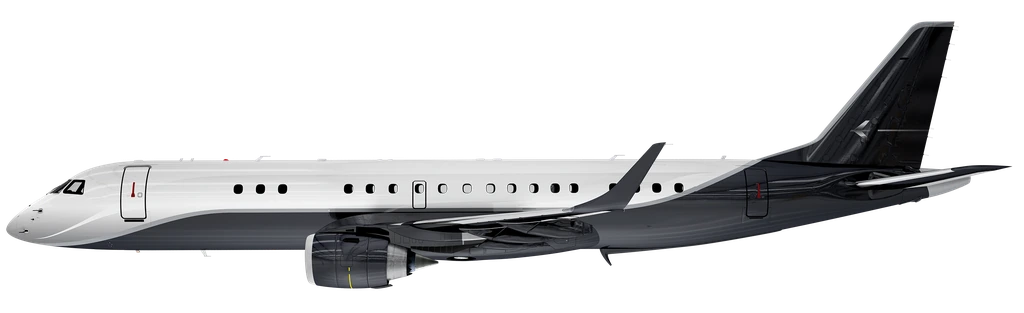
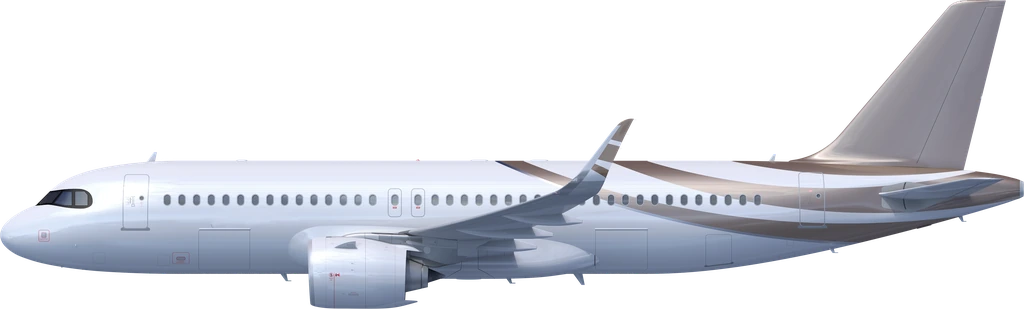
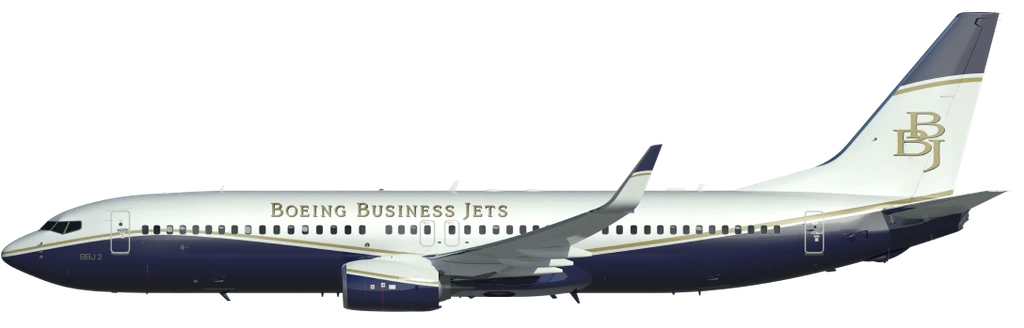
The ACJ TwoTwenty — 18 seats and 10,500 km; the ACJ320neo — 25 seats and 11,100 km; the BBJ 737-8 — 11,700 km with a 79 m² cabin; the Lineage 1000E — 19 seats and 8,500 km; the Sukhoi Business Jet — 19–23 seats and up to 7,200 km. Wide-body ACJ330neo and BBJ 787 cover 17,000–18,500 km — any pair of cities on the planet nonstop. Send us a request — we'll prepare options, calculate running costs and analyse the best fit for your task.
How does a business liner differ from neighbouring classes?
Cabin area is 60–270 m² versus 25–40 m² on a Global or Gulfstream: full bedrooms, a shower and a cinema appear. The flip side: a liner needs runways from 2,000–2,500 m and full airport infrastructure, an hour costs one and a half to two times more, and cruise is lower (M0.78–0.85 versus M0.90). Up to 12–15 passengers a jet is more rational; more — a liner. Send us a request — we'll prepare options, calculate running costs and analyse the best fit for your task.
Which business liners are in the fleet and how do they differ?
Fourteen aircraft: the Airbus ACJ line from the compact TwoTwenty to the wide-body ACJ350-9 (up to 19,000+ km), Boeing BBJ 737 MAX in three sizes and the long-range BBJ 787/777-8, the Embraer Lineage 1000E with five cabin zones, and the Sukhoi Business Jet — 19–23 seats at half the price of Western equivalents, supported in the CIS. Send us a request — we'll prepare options, calculate running costs and analyse the best fit for your task.
How do you choose an aircraft to buy for your needs?
Start from two numbers: the length of your typical route and the number of passengers. Up to 1,000 km and 4 people — a turboprop or light jet; 2,000–4,000 km — a midsize jet; nonstop intercontinental — a long-range jet. Then adjust for short runways, baggage volume and sleeping berths. We'll match a model to your profile and calculate the ownership economics. Send us a request — we'll prepare options, calculate running costs and analyse the best fit for your task.
New aircraft or pre-owned — which is the better buy?
A new aircraft means a factory warranty and a 1–3-year queue, but the price is at its peak. A pre-owned aircraft means immediate delivery and a price 30–60% lower, while engine time and history matter. For most buyers a fresh 3–7-year-old aircraft is optimal: the main depreciation has happened and plenty of life remains. We cost both options. Send us a request — we'll prepare options, calculate running costs and analyse the best fit for your task.