








Frequently asked questions
Pilatus PC-12 NGX: what kind of aircraft is it and what to consider when buying?
The Pilatus PC-12 NGX (2019–2025) gained the electronically controlled PT6E-67XP — the world's first production PT6 with FADEC — plus auto-throttle and a BMW Designworks cabin with enlarged windows. Eight passengers, a range of about 3,340 km and 537 km/h. It keeps the family's trademarks: unpaved strips, a cargo door and single-pilot operation. There is no flight attendant or hot meal service — the cabin is compact. There is no in-flight baggage access — bags are loaded on the ground. On typical legs it covers routes such as Vienna–Munich · Geneva–Ibiza. Send us a request — we'll prepare options, calculate running costs and analyse the best fit for your task.
How much does the Pilatus PC-12 NGX cost: purchase and running costs?
Guide figures for the Pilatus PC-12 NGX: average pre-owned price — $6.4M; new — $6.5M. Running costs at 300–400 h/year — about $645K/year, or $1,613 per flight hour. The final figure depends on year, hours flown, engine-programme status and configuration. Send us a request — we'll prepare options, calculate running costs and analyse the best fit for your task.
What is Pilatus known for and which aircraft does it build?
Switzerland's Pilatus makes two hits. The PC-12 is the best-selling single-engine turboprop in the world (over 2,000 built): 8–9 seats, 3,300 km, operation from unpaved strips as short as 750 m. The PC-24 is a unique 'off-road jet': jet speed of 815 km/h combined with unpaved-strip clearance and runways from 900 m. Both are famed for Swiss build and thoughtful design. Send us a request — we'll prepare options, calculate running costs and analyse the best fit for your task.
How reliable is the single-engine PC-12?
The fleet statistics answer better than words: 2,000+ PC-12s have logged over 10 million hours, with one of the best accident rates of any turboprop, including twins. The PT6A-67P engine, with 500 million family hours, runs 3,500 hours between overhauls. North American operators carry cargo and patients on the PC-12 around the clock — no tougher test exists. Send us a request — we'll prepare options, calculate running costs and analyse the best fit for your task.
How well does Pilatus hold value on the pre-owned market?
The PC-12 is a residual-value record-holder in general aviation: a ten-year-old aircraft keeps 65–75% of its price (a new NGX is ~$6.5M, a 2015 PC-12 NG $4.3–5M). The reason is perpetual scarcity: the aircraft's versatility keeps demand from charter, air-ambulance and cargo operators. A good aircraft's exposure rarely lasts more than a month. Send us a request — we'll prepare options, calculate running costs and analyse the best fit for your task.
How does the PC-24 differ from ordinary light jets?
The PC-24 is the only jet serially certified for gravel, grass and unpaved strips: it can use ~20,000 airfields worldwide instead of ~5,000. Plus a 1.25×1.30 m cargo door like a turboprop's and a flat 8–10-seat cabin floor. The price of versatility is range: 3,890 km versus 4,000+ for the CJ4. A new one is about $12M. Send us a request — we'll prepare options, calculate running costs and analyse the best fit for your task.
What routes and tasks suit turboprops?
Turboprops are the optimum for flights up to 1,500–2,000 km: London–Geneva, Paris–Milan, Vienna–Munich. Their element is short and unpaved strips: a Pilatus PC-12 lands in 600 m, so thousands of airfields are reachable that a jet physically cannot use. An hour costs one and a half to two times less than a jet, and on legs up to 1,000 km the time penalty is only 15–25 minutes. Send us a request — we'll prepare options, calculate running costs and analyse the best fit for your task.
What range and how many passengers do turboprops have?
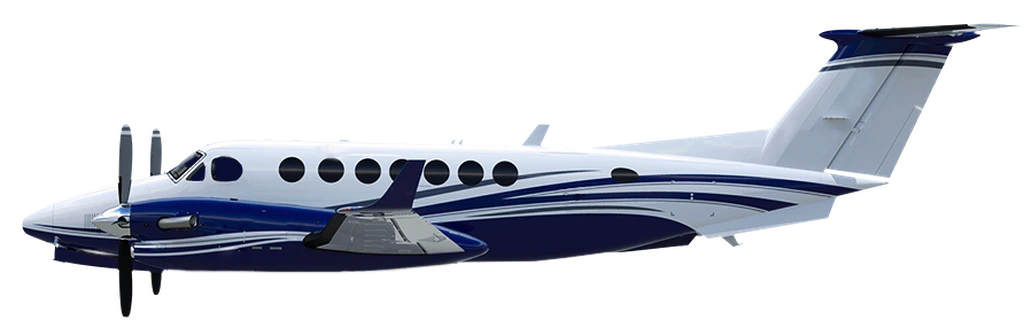
Single-engine aircraft take 4–9 passengers: the TBM 960 seats six over 3,200 km, the Pilatus PC-12 NGX up to nine over 3,400 km. The twin-engine King Air 360ER carries eight almost 5,000 km. Class cruise speed is 500–610 km/h. A rule of thumb: a full cabin cuts maximum range by 20–30%. Send us a request — we'll prepare options, calculate running costs and analyse the best fit for your task.
How does a turboprop differ from neighbouring classes?
A jet is faster — 750–850 km/h versus 500–610 — and flies higher, above turbulence. The turboprop answers with economics: 220–350 L/hour versus 500–700, a charter hour from $1,800 versus $3,000+, plus access to short unpaved strips. On legs up to 1,000 km the time difference is under half an hour, so short hops make sense by turboprop and long ones by jet. Send us a request — we'll prepare options, calculate running costs and analyse the best fit for your task.
Which turboprops are in the fleet and how do they differ?
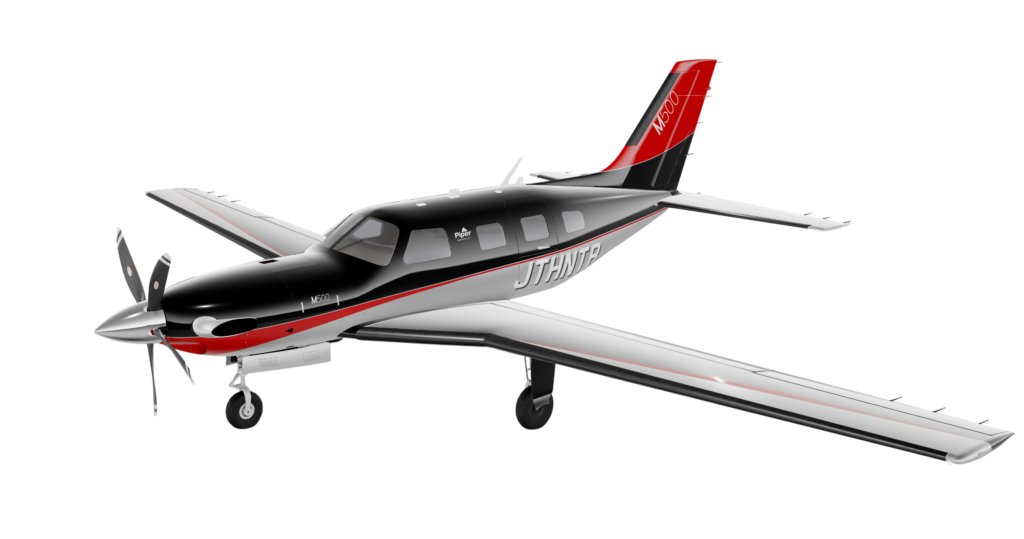
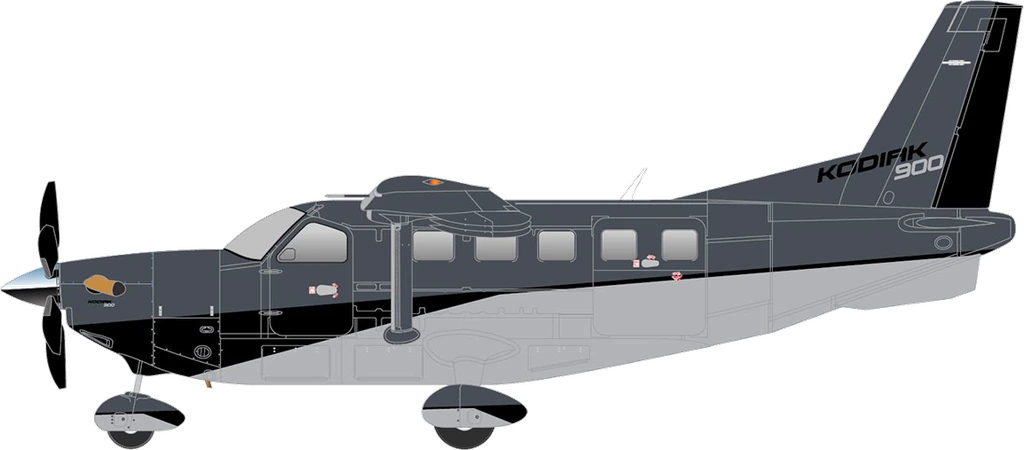
The fleet has 13 models: the fast Daher TBM 960 and Piper M700 Fury (556–611 km/h, 5–6 seats), the roomy Pilatus PC-12 NG/NGX/PRO with a cargo door and nine seats, the twin King Air 260 and 360ER for long legs up to 5,000 km, the business Piaggio Avanti Evo with jet speed and a stand-up cabin, and the affordable Piper M350/M500/M600SLS. Send us a request — we'll prepare options, calculate running costs and analyse the best fit for your task.
How do you choose an aircraft to buy for your needs?
Start from two numbers: the length of your typical route and the number of passengers. Up to 1,000 km and 4 people — a turboprop or light jet; 2,000–4,000 km — a midsize jet; nonstop intercontinental — a long-range jet. Then adjust for short runways, baggage volume and sleeping berths. We'll match a model to your profile and calculate the ownership economics. Send us a request — we'll prepare options, calculate running costs and analyse the best fit for your task.
New aircraft or pre-owned — which is the better buy?
A new aircraft means a factory warranty and a 1–3-year queue, but the price is at its peak. A pre-owned aircraft means immediate delivery and a price 30–60% lower, while engine time and history matter. For most buyers a fresh 3–7-year-old aircraft is optimal: the main depreciation has happened and plenty of life remains. We cost both options. Send us a request — we'll prepare options, calculate running costs and analyse the best fit for your task.