Short
Flight prices are calculated per hour of the entire aircraft, not per seat. Standard rates by class: turboprops range from $1,500 to $3,000 per hour, light jets from $3,000, mid-size jets from $4,500, and long-haul jets from $8,000. Airport taxes, ground handling, and aircraft delivery if based in another city are added to the rate. The cheapest option is a return empty leg flight, with a discount of 30–70%.
The question 'how much does a private jet cost' has no single answer: cost comes in layers — the price of the aircraft itself, the fixed costs of ownership and the variable costs of each flight. Understanding this structure matters more than any single figure, because it decides what is cheaper in a given case — owning or chartering.
Three components of cost
The first layer is the capital cost of purchase, from a few million dollars for a light jet to tens of millions for a long-range aircraft. Add depreciation: an aircraft loses roughly 7–10% of value a year depending on the market, so the resale price is usually well below the purchase price.
The second layer is fixed costs, which the owner carries regardless of hours flown: crew salaries and training, hull and liability insurance, hangarage, subscriptions and ground handling. By operators' estimates, fixed costs are a large share — often 40–60% of annual ownership cost.
The third layer is variable costs, which rise with hours: fuel, maintenance and engine reserves, airport and navigation fees, catering. Fuel is the largest single variable item.
What makes up an hour of flight
Direct hourly cost is fuel, engine reserves and maintenance. By industry estimates, fuel is typically about 25–35% of operating cost, maintenance 20–30%, crew 15–25%, and insurance and other fixed items the rest. Proportions shift with aircraft type and utilisation.
Geography matters too: navigation charges in Europe (EUROCONTROL) are materially higher than in North America. So the same aircraft type gives different hourly cost on different routes, and a correct estimate is always tied to a specific leg.
Own or charter
The key factor is annual hours. The industry benchmark: ownership starts to pay off at roughly 200 hours a year and above, because fixed costs are spread across more hours. Below that threshold, high fixed costs make charter or fractional ownership more sensible.
The mechanics are simple: fixed costs divided by hours flown. The same $1 million annual cost at 200 hours is $5,000 per hour; at 400 hours it is $2,500. That is why ownership economics improve with utilisation.
The practical test is a break-even calculation: divide annual ownership cost by a typical charter hourly rate to get the number of hours at which owning beats chartering. If real usage is below that, charter is cheaper.
Order of magnitude for hourly cost
To make the spread concrete, neutral benchmarks help. In AOPA's comparison of the hourly operating cost of 45 jets, at the low end the very light Cirrus Vision SF50 runs about $700 per hour, the heavy Gulfstream G650 around $5,100 per hour, and the Airbus ACJ320 business airliner roughly $8,400 per hour. These are approximate benchmarks, not exact rates: the actual figures depend on year, fuel prices and utilisation.
These are direct operating costs, not charter rates, but they show clearly how cost scales with class. Open reference databases such as an aircraft operating cost calculator also help estimate costs for a specific model, with seat count, fuel burn and annual maintenance budget per model.

Charter rates by class
Charter is paid for the whole flight, not per seat, and the hourly rate depends heavily on class: from turboprops and light jets at the low end to heavy, long-range and business airliners at the top. The spread is wide — from a few thousand dollars an hour to five-figure sums for large aircraft.
The final cost is not only hours: airport and handling fees, crew duty and accommodation, parking, catering, and on multi-leg trips the full time including repositioning. A correct price only comes from a specific route and dates.
Hidden and underestimated costs
First-time owners most often underestimate the fixed portion. Beyond the obvious items come navigation database updates, unplanned repairs and regulatory compliance — which can add tens of thousands a year. Older aircraft are cheaper to buy but costlier to maintain due to component wear.
A separate risk-management tool is hourly engine programmes, which remove the risk of an unbudgeted, expensive event and improve resale liquidity, since buyers prefer aircraft with transferable coverage.
How to reduce cost
The main lever is right-sizing the class to the actual mission. The most common source of unnecessary cost is operating an aircraft larger than the mission requires. Those regularly carrying two to four passengers on legs under 2,000 nautical miles rarely need a large cabin.
The second lever is offsetting fixed costs by chartering the aircraft out under management. Net charter income can cover a noticeable share of annual fixed costs, though it adds wear and compliance demands. The third is choosing a home base and enrolling in maintenance programmes for budget predictability.
Access forms and their economics
Ownership is not the only way. Fractional ownership shares the aircraft and part of the fixed costs among co-owners, lowering the entry barrier. Jet cards give a fixed hourly rate and predictability without ownership, usually with prepayment. On-demand charter means paying only for a specific flight.
The choice depends on annual hours. The industry benchmark: below about 150 hours a year charter or a card is cheaper; in the range of roughly 200–400 hours ownership starts to pay off; and at high utilisation, full ownership with possible managed charter to offset costs.

Residual value and reserves
Beyond running costs, two often-forgotten factors matter. The first is depreciation: the aircraft loses value every year, and at resale the gap between purchase and sale price can become the largest cost over the whole ownership period.
The second is reserves for expensive events: engine overhaul, scheduled heavy maintenance. Hourly engine programmes smooth this risk, turning a sudden large outlay into a predictable per-hour payment and improving resale liquidity. A sensible budget also holds a 10–20% contingency.
What drives the charter price
The cost of a specific flight comes from many factors beyond the hourly rate. The key ones: aircraft class and model, distance and number of segments, departure and arrival airports (fees vary), season and market load, and repositioning — if the aircraft must be brought from afar, that is billed.
Aircraft age matters too: newer aircraft with modern avionics and connectivity usually cost more per hour. Separate items include crew duty and accommodation on multi-day trips, parking at the destination, catering and special requests. This is why a correct price only comes from a specific route and dates, not a 'class average'.
New or pre-owned aircraft
At purchase, the first choice is between a new and a pre-owned aircraft. A new one costs more up front but usually comes with a warranty and gives more predictable expenses for the first few years, plus modern avionics and connectivity. A pre-owned one is cheaper to buy but needs a careful pre-purchase inspection and may carry higher maintenance costs due to component wear.
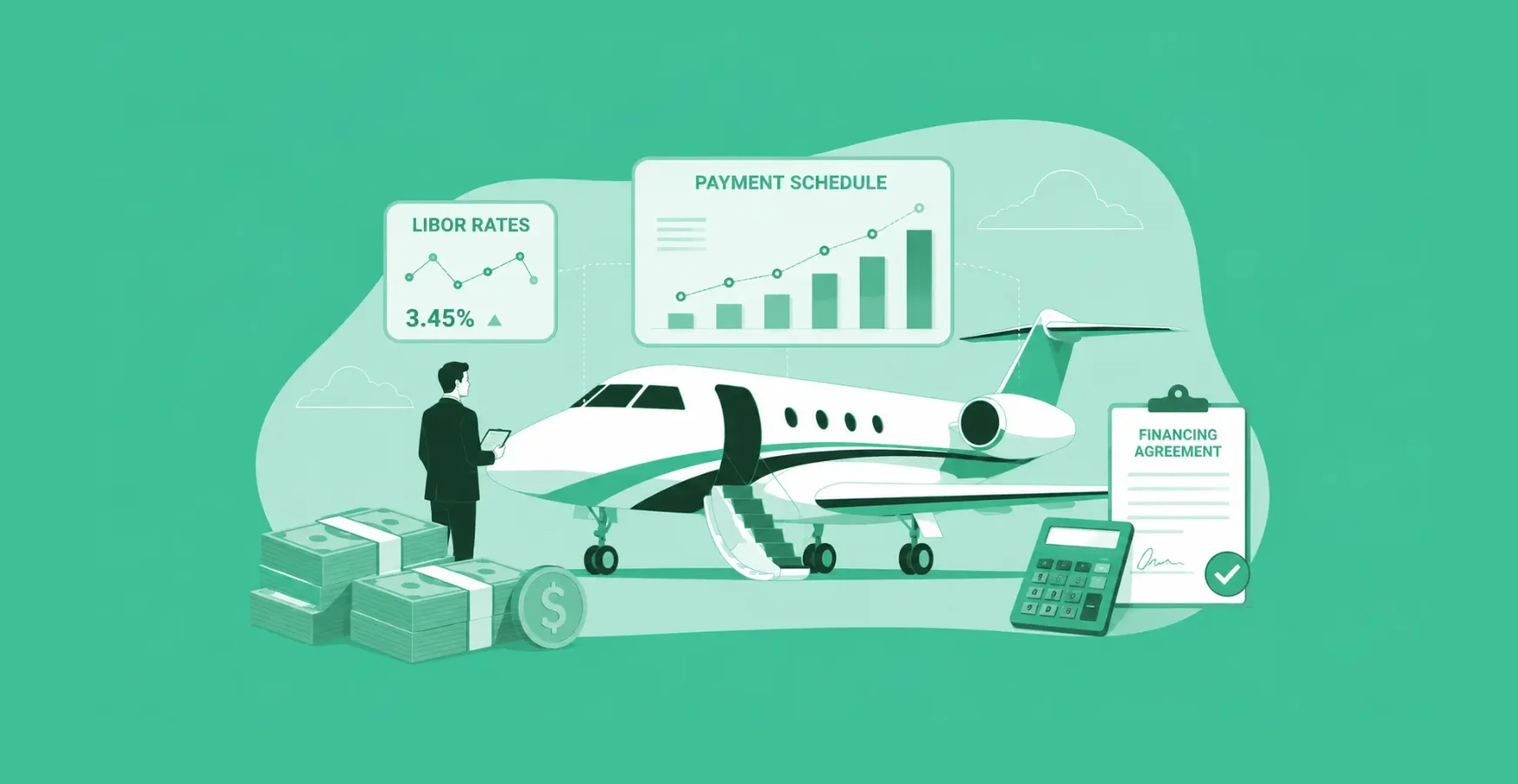
Financing adds another layer: aircraft loan rates and the cost of capital shape the final ownership economics. Many buyers also factor in potential charter income to partly offset costs. All these factors are calculated together, not in isolation.
How to budget for your case
The only correct calculation is against a specific flight profile: how many hours a year, which routes, how many passengers. From this follow the aircraft class, the access form (ownership, fractional, card, charter) and the break-even point. When comparing published specifications, remember that manufacturers state range to the standard NBAA IFR methodology — a fixed passenger count, crew and fuel reserves — so figures from different sources are only comparable under identical conditions. An abstract 'price of a private jet' means little without these inputs.
JetHunter provides access to more than 5,000 aircraft and a catalogue of 246 models with operating costs and range maps. That makes it possible to cost a real scenario — from selecting the right class to comparing ownership and charter against your utilisation.
«The most common mistake at purchase is taking a class larger than the mission requires. The calculation starts with the flight profile, not the budget.»
— Alexey Mordvintsev, CEO of JetHunter
Author: Alexey Mordvintsev, CEO of JetHunter, President of the Association of Professionals of Executive Aviation Industry (APIDA). Over 14 years in the industry.