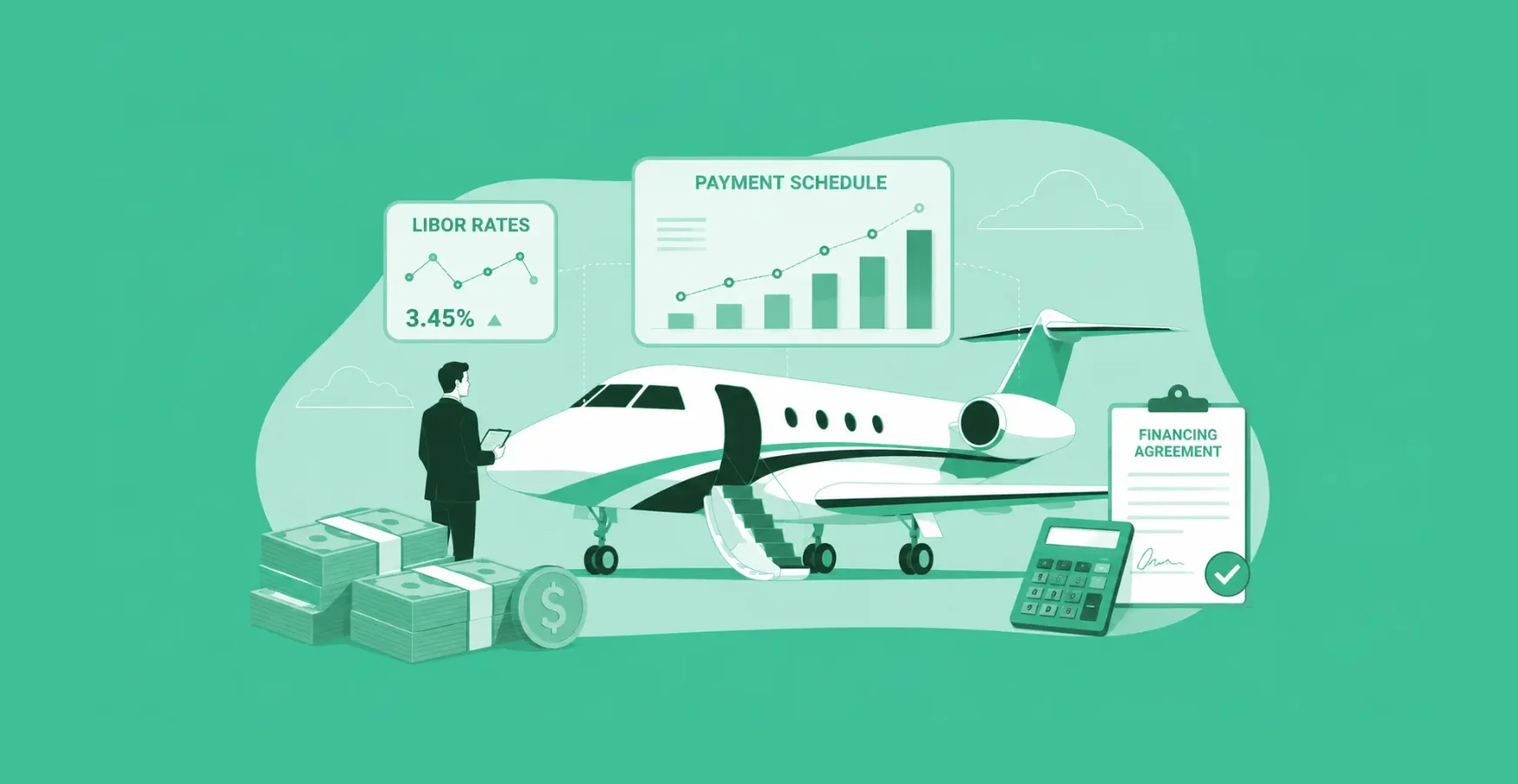
The question of "how much does it cost to maintain an aircraft" has no single answer: expenses are divided into fixed and variable, and the ratio between them changes completely depending on the annual flight time. Below, we'll break down the cost structure for turboprop aircraft, explore the regional specifics of Kazakhstan, and explain how to calculate them for your own scenario.
Two categories of expenses
Variable costs arise only when the aircraft is flying: fuel, engine and propeller program deductions, flight-related maintenance, airport and navigation fees, and crew travel expenses.
Permanent benefits do not depend on flight hours at all: hull and liability insurance, parking or hangar, crew salaries for permanent hire, calendar maintenance, subscriptions to navigation databases and communications.
It's the fixed cost that explains why the cost per hour varies so significantly with flight time. At two hundred hours per year, the fixed costs are spread over two hundred hours; at eight hundred, over eight hundred. The cost itself, however, remains constant.
What is included in variable costs?
Fuel is usually the largest expense. For turboprop aircraft, this is Jet A-1, which is available at all major airports in Kazakhstan, unlike aviation gasoline. Consumption depends on the type, flight mode, and load.
Engine and propeller programs are hourly deductions that turn future expensive repairs into a predictable hourly payment. For a turboprop aircraft, this is a significant expense, but it also eliminates the risk of a sudden, large expense and increases the aircraft's liquidity upon resale.
Flight-related maintenance, airport fees, and navigation complete the picture. A particular feature of the region is distance: flights in Kazakhstan are longer than in Europe, and with the same number of flights, more flight time is accumulated.
Fixed costs and regional specifics
Insurance depends on the aircraft's value, crew experience, and flight geography. Hangar storage in Kazakhstan is not a luxury, but a necessity: the harsh continental climate, with severe winter frosts and high summer temperatures, reduces the lifespan of an aircraft's paintwork and interior when parked outdoors.
Winter operation adds costs that don't exist in warmer regions: de-icing, pre-launch heating, and additional preparation time. These costs aren't always included in standard calculations, but they are noticeable in the annual budget.
Service support is a separate issue. Some work on turboprop aircraft is performed locally, while others require ferries. The cost of ferries and downtime is factored into the budget upfront, rather than incurred afterward.
How the raid changes the picture
A practical example of logic. Let's say fixed costs are $100,000 per year, and variable costs are $800 per hour. At two hundred hours per year, the hourly rate is $1,300; at four hundred, $1,500; at eight hundred, $925.
The figures are arbitrary, but the proportion is real: the difference between low and high flight hours can reach 40 percent of the hourly cost. That's why an aircraft is matched to the planned flight hours, and not the other way around.
This also leads to a conclusion about the threshold of feasibility. With low flight hours, chartering is usually cheaper than owning, and the industry benchmark for transitioning to private jet ownership starts at approximately two hundred hours per year.
Differences between classes
In the turboprop segment, the range is significant. Single-engine aircraft with a pressurized cabin, like Piper M500 и M700 Fury provide lower costs with less capacity and range.
High-speed aircraft class Daher TBM 960 They save on travel time, which is important on long Kazakhstani routes. While the cost is higher, the benefits are also higher: the plane can cover more ground in the same day.
Aircraft for difficult sites - Kodiak 100 Series III — are calculated differently. Their value isn't in speed, but in access to airfields where other types can't land, and the cost is calculated based on what replaces the flight: a ground trip that takes several hours, or no trip at all.
Distance as an economic factor
Kazakhstan is the ninth-largest country in the world by area, and this changes the calculations compared to European scenarios. The typical flight distance between regional centers here is longer than an international flight in Europe.
The practical implications are twofold. On the one hand, the flight time for the same number of trips is higher, meaning fixed costs are better distributed and the hourly rate is lower. On the other hand, the absolute amount of variable costs increases.
The second effect: on long flights, the difference in cruising speed between types translates into actual hours. An aircraft that gains 50 knots on a 1,500-kilometer route saves a significant portion of the flight time.
Hangar or open parking
For Kazakhstan, this isn't a matter of comfort, but rather a matter of resources. The harsh continental climate, with temperatures down to -30°C in winter and scorching temperatures exceeding -35°C in summer, impacts paintwork, seals, glazing, and interiors.
An aircraft stored outdoors year-round deteriorates faster and requires more frequent refinishing. This is reflected in the resale price—the buyer can see the aircraft's condition and draw conclusions about its maintenance.
Hangar storage is more expensive than open parking, but the difference is partially offset by residual value and reduced restoration costs. For expensive turboprop aircraft, the cost is usually in favor of a hangar.
Crew: Hire or fly yourself
For a turboprop aircraft, this is a decision with a significant impact on the budget. A permanently hired pilot is a significant fixed expense, but it alleviates the issue of qualifications and availability.
An owner who pilots themselves saves on this item, but assumes the requirements for training and maintaining a certification: periodic inspections, simulator training, and flight time to maintain qualifications. These expenses are less than the salary, but they are not zero.
An intermediate option is to use a pilot as needed. This is suitable for low flight hours and a predictable schedule, but it doesn't work well when flights are urgent.
Charter under management
If the aircraft is used infrequently, some of the costs can be offset by chartering it under an operator's management. The resulting income can cover a significant portion of the fixed costs.
But this comes at a price: flight hours and wear and tear increase, commercial certification requirements are added, and the aircraft isn't always immediately available to the owner. The decision is made based on the owner's actual flying time.
For Kazakhstan, there are regional specifics: the charter market there is smaller than in Europe, making it more difficult to count on stable occupancy. Charter revenue should be calculated conservatively rather than based on an optimistic scenario.
What is most often forgotten?
The first is depreciation. An aircraft loses value every year, and over a five- to seven-year period, this loss often exceeds all direct operating costs. It's not visible in the cost table, but it's present in the real economics of ownership.
Second, there's a reserve for the unexpected. Unit failure, maintenance damage, unscheduled airworthiness directives. A reasonable practice is to include a reserve of approximately ten to twenty percent above the estimated budget.
Third, downtime. Days when an aircraft is not flying due to maintenance, waiting for parts, or weather conditions reduce the actual flight time, which means the cost of each hour flown increases.
How to count for yourself
A proper calculation starts not with a model, but with a flight profile: how many hours per year, which routes, how many passengers, which landing sites. From this, the aircraft class is determined, and from that, the economy.
An important note regarding the figures: the calculations in the model datasheets are based on a specific fuel price. As the price changes, the proportions change, so in your own calculations, you should use the current price for your region, not the average.
You can insert your own input data - flight hours, routes, fuel price, operating scheme - in cost of ownership calculator. It calculates for a specific scenario, not based on average values, and this is the only way to get a figure that applies to your situation.
JetHunter supplies Piper and Daher turboprop aircraft to Kazakhstan and helps calculate the economics of ownership based on a real-world flight profile, including regional factors such as distances, climate, and service availability.
«"The cost per flight hour depends more on the number of hours flown than on the model. The same aircraft flown two hundred hours a year and one flown eight hundred hours a year represent two different economics, with the difference being up to twofold."»
— Alexey Mordvintsev, CEO of JetHunter
Author: Alexey Mordvintsev, CEO of JetHunter, President of the Association of Business Aviation Professionals (APIAP). Over 14 years in the industry.