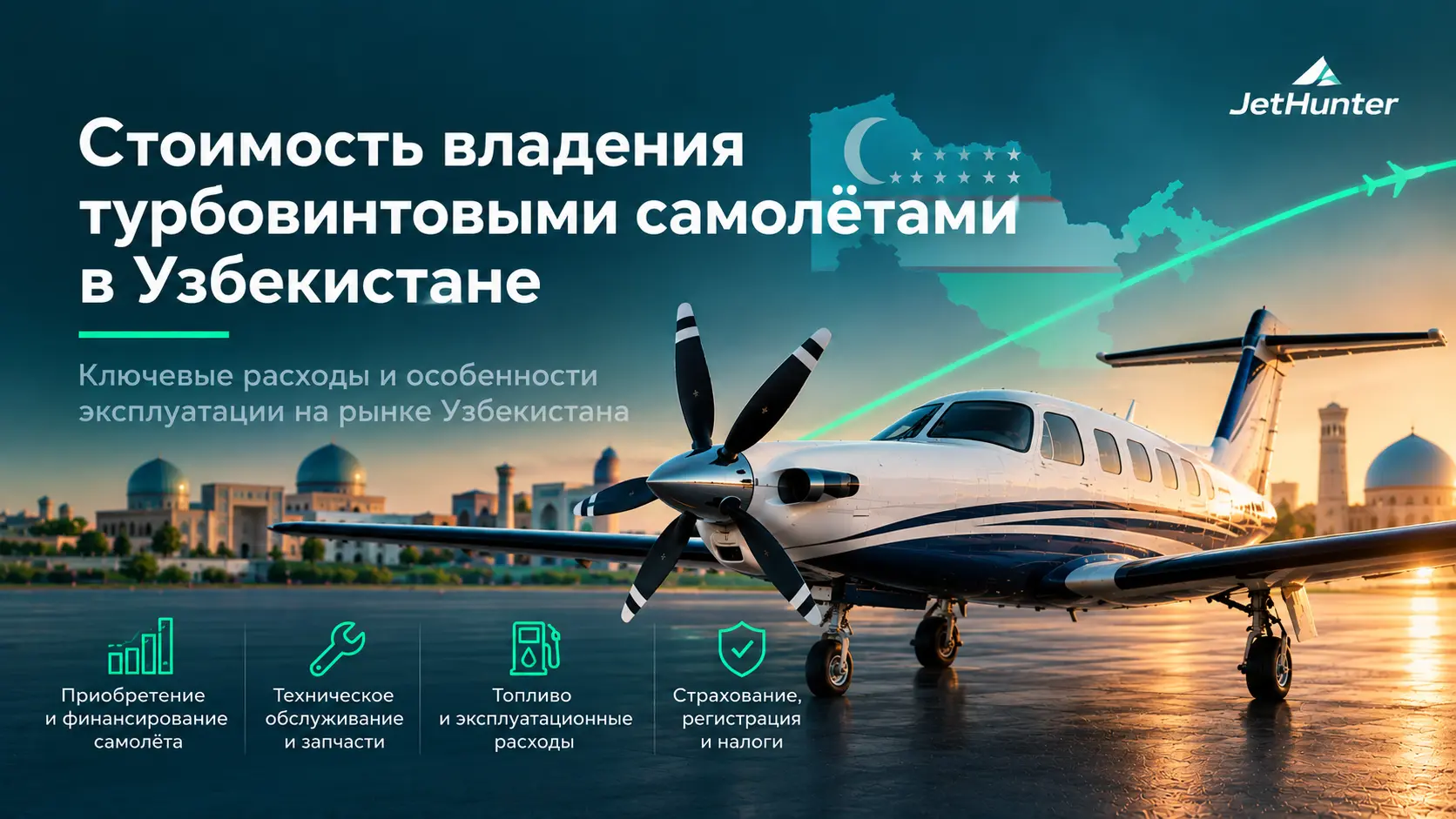
The question of "how much does it cost to maintain an aircraft" has no single answer: expenses are divided into fixed and variable, and the ratio of these varies depending on the annual flight time. Below, we analyze the cost structure for turboprop aircraft and the specifics of Uzbekistan.
Two categories of expenses
Variable costs arise only when the aircraft is flying: fuel, engine and propeller program deductions, flight-related maintenance, airport and navigation fees, and crew travel expenses.
Permanent benefits do not depend on flight hours: hull and liability insurance, parking or hangar, crew salaries for permanent hire, calendar maintenance, subscriptions to navigation databases and communications.
It's the fixed cost that explains why the cost per hour varies so much with flight time. At two hundred hours per year, the fixed costs are spread over two hundred hours; at eight hundred, over eight hundred. The cost itself doesn't change.
Fuel: Where is Uzbekistan more convenient?
Jet A-1 fuel is used for turboprop aircraft, and here the specificity of Uzbekistan plays to the owner's advantage. Kerosene is available in Tashkent, Samarkand, Bukhara, and Urgench—all airports that receive scheduled flights.
This distinguishes turboprop aircraft from piston engines, for which aviation gasoline remains a niche imported product with an irregular supply. When calculating economics, this factor often proves decisive even before performance.
Engine and propeller programs are hourly deductions that transform future expensive repairs into a predictable payment. For a turboprop aircraft, this is a significant expense, but it eliminates the risk of unexpected expenses and increases the aircraft's liquidity upon resale.
Fixed costs and climate
Insurance depends on the aircraft's value, crew experience, and flight geography. Hangar storage in Uzbekistan is necessary due to the climate: summer temperatures above 40°C and high solar activity reduce the lifespan of paintwork, glass, and interiors.
Winters are milder than in Kazakhstan, so de-icing costs are lower, but not zero: in northern regions and in the mountains, winter operations require preparation.
Service support is a key issue in the emerging market. Some work is performed in-country, while others require transportation to Kazakhstan, the UAE, or Turkey. The cost of transportation and downtime is factored into the budget upfront.
How the raid changes the picture
A practical example of logic. Let's say fixed costs are $100,000 per year, and variable costs are $800 per hour. At $200 per hour, the hourly rate is $1,300; at $400 per hour, $1,500; at $800 per hour, $925 per hour.
The figures are arbitrary, but the proportion is real: the difference between low and high flight hours can reach 40 percent of the hourly cost. Therefore, a vehicle is selected based on the planned flight hours, and not the other way around.
The industry benchmark for transitioning to owning a car starts at approximately two hundred hours per year. Below this threshold, freight is usually cheaper—but in Uzbekistan, there's a caveat to this rule, which is discussed below.
Local market adjustment
There is one registered operator in the republic with its own air operator certificate. Practical implications: a significant portion of private flights are operated by aircraft from Kazakhstan, the UAE, or Turkey, with the delivery time taking between one and a half and three hours and charged at the same price as the flight.
This changes the arithmetic of comparing ownership and chartering. The cost of a charter flight here includes roundtrip transportation, so the practicality of owning a private jet is reached earlier than in countries with developed local markets.
The downside: it's more difficult to count on income from chartering an aircraft under management. The market is small, occupancy rates are variable, and it's best to plan for recouping expenses this way conservatively.
Distances and routes
Uzbekistan is more compact than Kazakhstan, and domestic routes are shorter: Tashkent to Samarkand takes about forty minutes, Tashkent to Bukhara about an hour, and Bukhara to Urgench about forty minutes. The same road trips take four to eight hours.
The practical implications are twofold. Shorter legs mean fewer flights for the same number of trips, meaning fixed costs are less easily distributed. But the time savings over ground transportation are greatest here—it's precisely over these distances that aviation delivers its greatest benefits.
International routes change the picture: Dubai is about three hours, Istanbul is about four and a half, and Moscow is about four. They require a different class of vehicle and a different schedule.
Differences between classes
Single-engine machines with a pressurized cabin like Piper M500 и M700 Fury They offer lower costs with smaller capacity and range. Their capacity is sufficient for domestic routes within Uzbekistan.
High-speed class cars Daher TBM 960 They win on international routes, where the difference in cruising speed can amount to hours. On short domestic routes, the advantage is less noticeable.
Machines for difficult sites - Kodiak 100 Series III — are calculated differently: their value lies in access to airfields where other types cannot land, and the economy is calculated based on what the flight is replaced with.
What is most often forgotten?
The first is depreciation. An aircraft loses value every year, and over a period of five to seven years, this loss often exceeds all direct operating costs.
Second, there's a reserve for the unexpected: unit failure, maintenance damage, unscheduled airworthiness directives. A reasonable practice is to budget 10 to 20 percent more than the estimated budget.
Third, downtime. Days when an aircraft is not flying due to maintenance or waiting for parts reduce the actual flight time and increase the cost of each hour flown. In the emerging service market, this factor is more significant than usual.
Crew and training
For a turboprop aircraft, the decision to hire a pilot has a significant impact on the budget. A permanently hired pilot is a significant fixed cost, but it alleviates the issue of qualifications and availability.
An owner who pilots himself saves this item, but accepts the requirements for training and maintaining the approval: periodic checks, simulator training, flight time to maintain qualifications.
In the context of an emerging market, the issue of accessibility of training per type is added: some training takes place abroad, and this is factored into the plan in advance.
How to count for yourself
A proper calculation starts not with a model, but with a flight profile: how many hours per year, which routes, how many passengers, which landing sites. From this, the aircraft class is determined, and from that, the economics.
The calculations in the model datasheets are based on a specific fuel price. As the price changes, the proportions change, so in your own calculation, you should use the current price for your region.
You can substitute your input data in cost of ownership calculator - He calculates for a specific scenario, and not based on average values.
JetHunter supplies Piper, Pilatus, and Daher turboprop aircraft to Uzbekistan and helps calculate the economics of ownership for a real-world flight profile, including aircraft supply and service availability.
«"There's only one operator with an air operator certificate in the country, so calculating charter income is conservative. Owning your own aircraft here pays for itself through accessibility, not rental."»
— Alexey Mordvintsev, CEO of JetHunter
Author: Alexey Mordvintsev, CEO of JetHunter, President of the Association of Business Aviation Professionals (APIAP). Over 14 years in the industry.