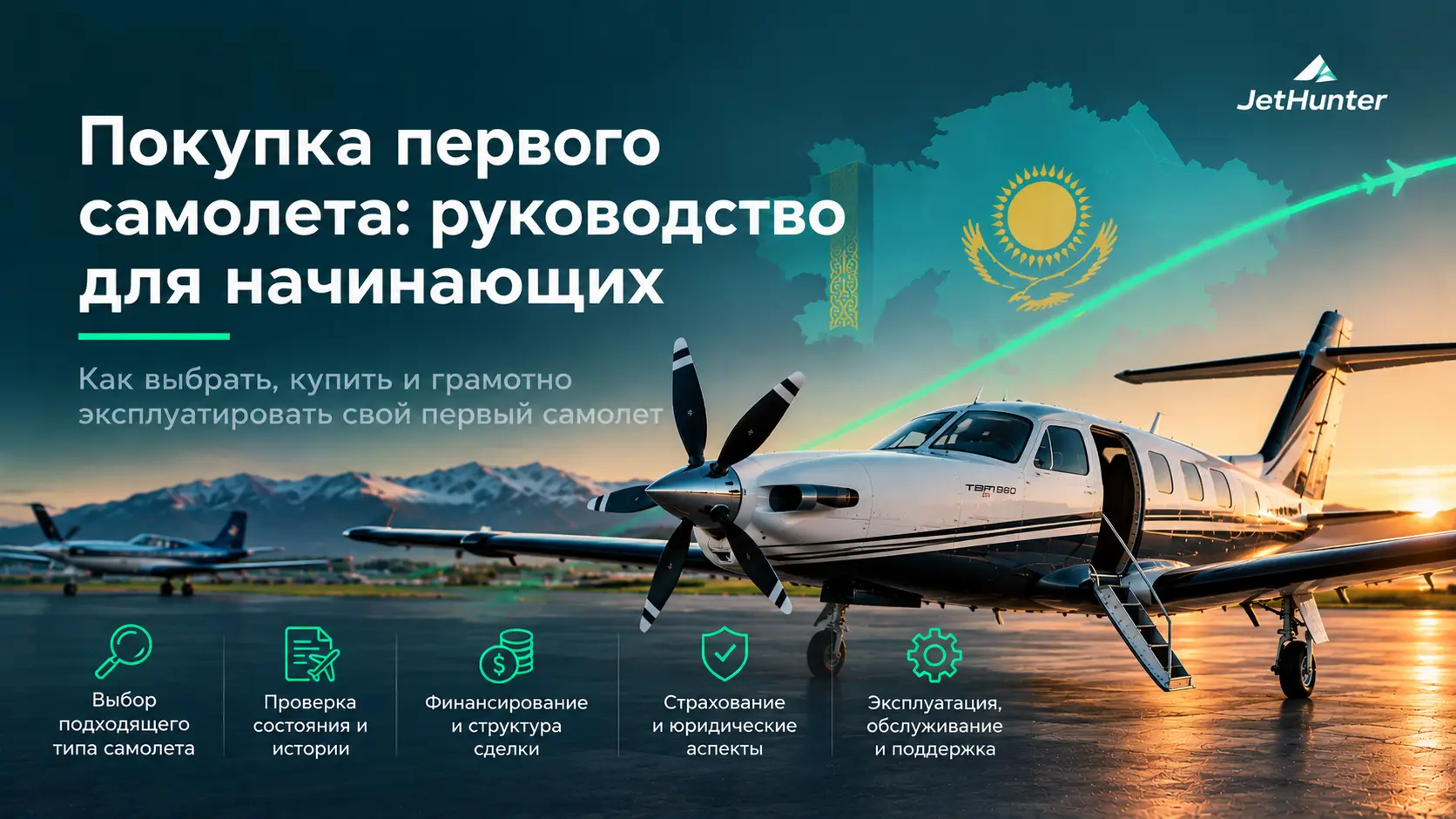
Buying your first aircraft differs from subsequent ones in that the buyer has no operating experience to rely on. Decisions must be made based on calculation, not habit. Below, we discuss the questions to start with, how to navigate the journey from a light aircraft to a more serious one, and what to avoid.
The first question is not about the plane.
It's worth starting with your flight profile, not your models. How many hours per year do you plan to fly, what routes will be scheduled, how many passengers are typically on board, where from and to, and what time of year. These four or five answers will determine the aircraft class more accurately than any comparison of characteristics.
The second question is who will pilot it. An owner who obtains a license and flies themselves, and an owner who hires a pilot, each approach different aircraft. In the former case, simplicity and forgiving handling are important, while in the latter, comfort and performance are key.
The third factor is where the aircraft will be based and serviced. The availability of a hangar, the availability of the right fuel, and a service organization within reasonable proximity have a greater impact on operation than the differences between similar models.
Logic of steps
Most owners don't reach the point of owning a serious aircraft right away. The typical path begins with a single-engine piston aircraft: it's easier to fly, cheaper to operate, and allows you to gain experience without major risks.
In the Piper line this stage corresponds to Archer LX — the same proven Cherokee platform as the training aircraft, but in an owner-specific configuration. It offers clear economics and smooth handling, essential for a pilot with limited flight experience.
The next step is an aircraft with a pressurized cabin and a longer range. Piper M350 It retains the piston powerplant and its associated fuel consumption, but adds altitude, a six-seat cabin, and the ability to fly above the weather rather than in it.
Next comes the transition to the turbine. Piper M500 — the same cabin size with a turboprop engine: higher speed and altitude, improved reliability, and improved fuel economy. For many owners, this is the ultimate destination, as the aircraft fulfills the bulk of regional missions.
Piston or turbine
The key difference isn't speed, but operational characteristics. Piston-engined aircraft are cheaper per hour and easier to maintain, but they are limited in altitude, speed, and ability to fly in challenging conditions.
Turboprops perform better and faster, and are more reliable in terms of failure rates, but they require a different level of pilot training and significantly higher costs. The transition threshold is determined not by prestige, but by whether the actual flight profile reaches the limitations of piston-engined aircraft.
A separate regional factor: turboprop aircraft run on Jet A-1, which is available at all major airports in Kazakhstan, while piston aircraft require aviation gasoline, which is scarce in the country. For some owners, this proves to be a decisive factor, even more so than performance.
New or used
A new aircraft comes with a factory warranty, modern avionics, and predictable first-year costs, but requires a delivery wait that, for popular models, ranges from months to up to a year.
A used aircraft is readily available and cheaper to purchase, but requires a thorough pre-purchase inspection and carries the risk of accumulated problems. For a first-time buyer, who has no experience assessing its condition, this is a significant consideration.
A reasonable compromise for a first aircraft is a new, entry-level aircraft or a used one with full documentation and a verified history, purchased with professional transaction support.
How does the purchase process work?
For a new aircraft, the process is shorter than for a used one: determining the configuration, placing an order, waiting for production, acceptance at the factory, ferrying and registration in the home country.
Configuration is a key step. Avionics, interior, and additional equipment are selected at the time of order, and changing them later is more expensive. At this stage, it's best to base your flight profile on your actual flight profile rather than accepting the default maximum configuration.
Preparations for import and registration are ongoing in parallel with production. Delivery times are measured in months, and this window is used to collect documents rather than wait.
Own or charter
This is a question worth addressing before choosing a model. The industry benchmark for transitioning to private jet ownership begins at approximately two hundred flight hours per year: below this threshold, chartering is usually cheaper, taking into account all fixed costs.
But flight hours aren't the only criteria. Owning a private jet offers instant availability, control over its configuration, and the ability to fly to destinations difficult to charter. For an owner with distributed assets, this can outweigh the arithmetic.
Intermediate forms also exist: fractional ownership divides the aircraft and fixed costs between several owners. This market is still in its infancy in Kazakhstan, but for two or three partners with compatible objectives, the scheme works.
Training and Admission
If the owner plans to fly independently, training begins alongside the aircraft selection process, not after purchase. This includes obtaining a private pilot's license, then an instrument rating, and, if upgrading to a more complex aircraft, type rating training.
The timeframe here is measured in months and depends on the intensity of training, weather, and instructor availability. It's a good idea to begin training before signing the aircraft contract, so that the certification is ready by the time the aircraft is delivered.
Maintaining qualifications is a separate issue. A pilot who flies infrequently loses skill, and that's precisely why periodic checks are required. When planning, it's important to honestly assess whether the actual flight time will be sufficient.
How much does it cost besides the plane?
The price of an aircraft is supplemented by fixed costs that begin immediately after purchase: insurance, hangar storage, scheduled maintenance, and navigation database subscriptions. These costs are independent of whether you fly or not.
For a new aircraft, import and registration procedures are added: customs payments, registration with the registry, and obtaining an airworthiness certificate. These costs and deadlines are included in the project budget along with the cost of the aircraft.
A reasonable practice for a first aircraft is to build in a reserve of approximately ten to twenty percent above the estimated first-year budget. Experience shows that unexpected events often arise during this period, while the owner develops an understanding of its operation.
Typical mistakes
The first and most expensive option is to buy for a rare scenario. The owner buys the aircraft for long-haul flights that happen two or three times a year, and pays for unused capacity on the remaining days. Chartering is cheaper for rarer missions.
The second is to calculate the cost based on the purchase price, not the hourly rate. A cheap-to-buy aircraft with expensive or hard-to-find fuel and complex maintenance will cost more over several years than a more expensive one at the outset.
Third, failing to factor in associated costs: hangar, insurance, pilot training, maintenance, and, for a new aircraft, import and registration procedures, which occur simultaneously with delivery and take time.
Fourth, underestimating the qualification requirements. Upgrading to a more complex aircraft requires training, and this training is planned before purchase, not after.
Where to start practically
Make a list of actual routes for the past year: where you flew and how you got there. Calculate how many of them could be covered by your own aircraft and how many hours that would add. Check the availability of airfields, fuel, and service on these routes.
Then calculate the economy for the resulting raid: substitute your input data into cost of ownership calculator and compare it with the charter cost for the same missions. If the figures don't add up, the issue isn't the model, but whether the aircraft is needed at all.
JetHunter supplies new Piper and Daher aircraft to Kazakhstan and Uzbekistan, helping clients navigate the entire process from flight profile to specific model—including economics calculations, import and registration procedures, and operator assignment.
«"You choose your first plane not based on your dreams, but on what you'll be doing with it every week. A plane bought for a rare scenario is expensive and sits on the ground."»
— Alexey Mordvintsev, CEO of JetHunter
Author: Alexey Mordvintsev, CEO of JetHunter, President of the Association of Business Aviation Professionals (APIAP). Over 14 years in the industry.