

Frequently asked questions
Which aircraft are chosen for business travel?
For business trips the key criteria are speed, punctuality, Wi-Fi and a work zone. For 2–4-hour legs, light and midsize jets are used; for 5–8 hours, super-midsize and large jets, where the flight becomes a working day: a table, connectivity, hot meals and a flight attendant. Priority goes to airports closer to the business centre. Send us a request — we'll prepare options, calculate running costs and analyse the best fit for your task.
Why is a private jet better for business than scheduled flights?
Time savings: departure on your schedule, no queues or connections, landing at an airport closer to your goal. In a day you can visit 2–3 cities and return home. In the cabin: confidential meetings, Wi-Fi and meeting prep. For a team of 4–8 it is often faster and more productive than business class. Send us a request — we'll prepare options, calculate running costs and analyse the best fit for your task.
How much does a business flight cost and what drives it?
The cost depends on class, distance and number of passengers. A charter guide: light jet from $3,000/hour, midsize from $4,500, super-midsize from $5,500. A one-day business loop London–Geneva–Vienna on a midsize jet is $35–50K. We prepare an exact calculation for the specific route and schedule. Send us a request — we'll prepare options, calculate running costs and analyse the best fit for your task.
Which aircraft should a business buy and what does ownership cost?
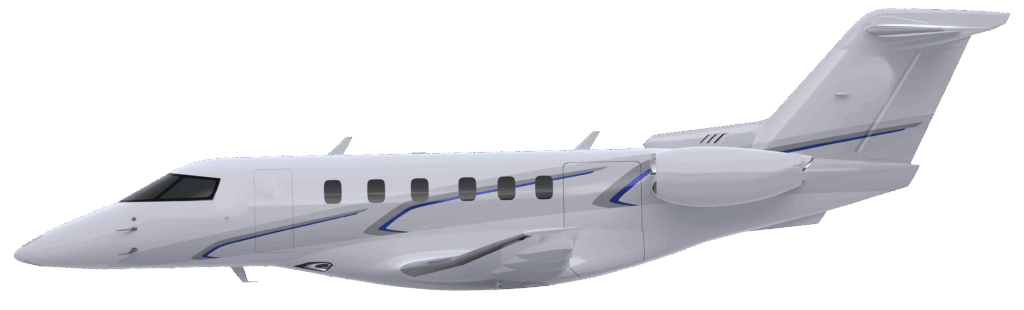
For regular business flights a midsize or super-midsize jet is optimal: the Praetor 600 (pre-owned ~$17.8M, running ~$2.7M/year at 400 h) or the Challenger 3500. From 300–400 h/year, buying beats chartering. We cost every scenario against your schedule. Send us a request — we'll prepare options, calculate running costs and analyse the best fit for your task.
How does a deal work: stages and timeline from deposit to handover?
The standard path takes 6–10 weeks. Step 1: a letter of intent (LOI) with price and terms — 3–5 days. Step 2: a 5–10% deposit into escrow and signing of the purchase agreement. Step 3: a pre-purchase inspection — 1–3 weeks. Step 4: rectification of findings and price adjustment. Step 5: closing — simultaneous transfer of funds, title and risk, technical acceptance and ferry of the aircraft.
What is a pre-purchase inspection and who pays for it?
A pre-purchase inspection (PPI) is an independent check at a certified centre: airframe, engines, corrosion, records and compliance with airworthiness directives. It takes from 3 days on a turboprop to 2–3 weeks on a heavy jet and costs $15–100K — paid by the buyer. By market practice the seller pays to rectify airworthiness-affecting defects. A seller refusing a PPI is grounds to walk away.
What taxes and duties apply when importing and registering an aircraft?
The import budget depends on jurisdiction. In the EU the main items are any customs duty (most business-jet codes carry reduced or zero rates) and import VAT, which varies by country of entry (for example 19–22% in much of Europe). Registration in Aruba, San Marino or the Isle of Man under operation outside the EU allows a temporary-admission regime. We produce an exact calculation before the LOI is signed — an error here costs millions.
What should you do after buying an aircraft?
After purchase the aircraft must be entered into service: choose a registry (Aruba, San Marino, Isle of Man or a national one), sign a management and maintenance contract with an operator, enrol the engines on a programme (ESP/JSSI), arrange insurance, hangar and crew, and plan the first maintenance. We support all of these steps. Send us a request — we'll prepare options, calculate running costs and analyse the best fit for your task.
How do you verify an aircraft's legal status and history before buying?
Before a deal we check: title and absence of liens or leases (a registry title search), the full maintenance history and airworthiness-directive records, the status of heavy maintenance checks and engine time remaining, any incident involvement, and compliance with export rules. We organise this review and an independent pre-purchase inspection before any funds move. Send us a request — we'll prepare options, calculate running costs and analyse the best fit for your task.
How much does it cost to run a private jet?
Running costs depend on utilisation and aircraft class. Budget for fixed and variable items:
- Crew and support staff;
- Fuel and navigation charges;
- Maintenance and insurance;
- Hangar storage and airport fees;
- Management company fee.
A light jet flying 200 hours a year typically costs from USD 700,000 annually; a long-range aircraft on the same utilisation runs into several million. We prepare a cost-of-ownership calculation for the specific aircraft before you commit, so the budget holds no surprises.