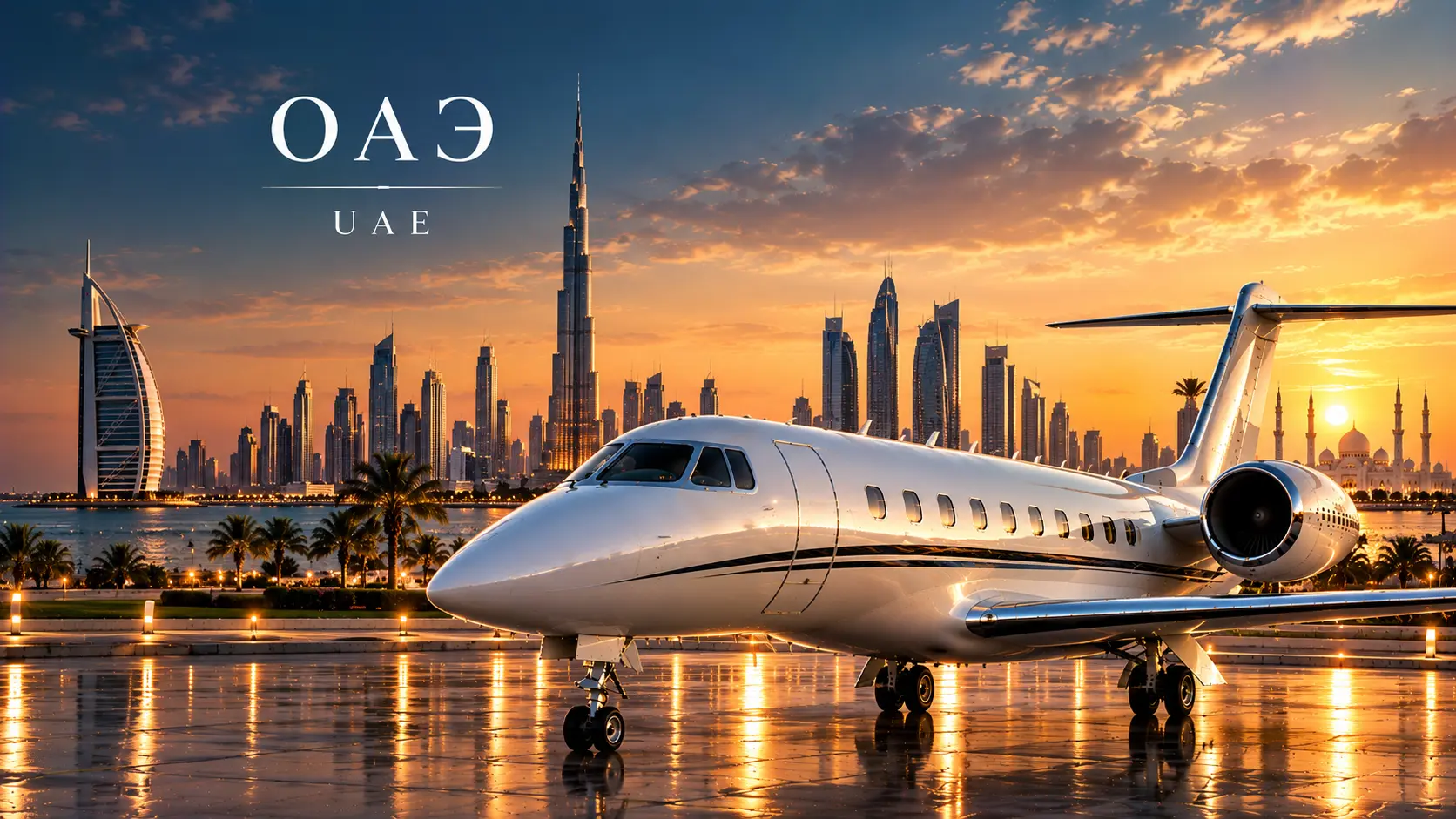
The UAE is one of the world's most convenient regions for business aviation: several airports, a developed FBO network, round-the-clock operation and a position at the crossroads of routes between Europe, Asia and Africa. Below we cover the Dubai and Abu Dhabi fields, the differences between them and practical planning.
Al Maktoum: the business-aviation airport
Al Maktoum (DWC/OMDW) in Jebel Ali, about 37 kilometres southwest of central Dubai, is the preferred field for private flights. Its 4,500-metre runway accepts every category of aircraft including ultra-long-range jets and VIP airliners, and the airport operates around the clock.
The emirate's main business-aviation infrastructure is concentrated here: per industry data, DWC hosts five FBOs — DC Aviation Al-Futtaim and ExecuJet in standalone terminals, plus Jet Aviation, Falcon Aviation and Jetex sharing a building.
The drive to central Dubai takes around 40 minutes, to Abu Dhabi a little over an hour depending on traffic. Lower congestion than the main hub gives faster ground movement and scheduling flexibility.
Dubai International: why it is harder
Dubai International (DXB/OMDB) remains the main commercial hub and has private terminals, but for business aviation it carries a significant constraint: the airport has been Level 3 slot coordinated since 2010.
The practical consequence is that peak-hour slots are scarce, and part of business aviation is pushed toward Al Maktoum. DXB is chosen when a connection to a scheduled flight is needed or when route and timing allow a slot to be secured.
Abu Dhabi and Al Bateen
The capital is served by Zayed airport and by Al Bateen — a rare field in the region dedicated to business aviation. That delivers privacy and fast procedures without competing for slots with airlines.
Al Ain serves as an additional field. Distances between the emirates are short: aircraft and ground transport move freely between Dubai and Abu Dhabi, making the choice of airport a matter of convenience rather than availability.
Routes and flight times
Dubai is geographically convenient as a hub: Moscow to Dubai is about 5 hours, Almaty to Dubai around 4 hours, Istanbul to Dubai about 4 hours, London to Dubai around 7 hours, Tokyo to Dubai about 9 hours 30 minutes.
Short regional legs: Doha about 50 minutes, Riyadh around 1 hour 30 minutes, Muscat about an hour. The Maldives is around 4 hours 15 minutes, making the 'Dubai plus islands' pairing one of the region's most requested routes.
Seasons
High season runs November to April, when temperatures are comfortable. The summer months from June to September are very hot and the flow shifts: residents leave and visitor numbers fall.
Peak loads come from major events — exhibitions, sporting fixtures, the air show. On those dates demand for slots and parking rises and planning must be done ahead, while at other times a flight is arranged quickly.
Practical planning
The first question is the airport. Al Maktoum when speed and freedom from type restrictions matter, DXB for a scheduled connection, Abu Dhabi when the programme is in the capital. The second is permits: they are arranged through a ground agent in advance under the rules of the UAE General Civil Aviation Authority (GCAA).
The third is parking on a longer visit: the region's infrastructure allows aircraft to be accommodated without repositioning to another country, which distinguishes the UAE favourably from European destinations.
Choosing an aircraft
There are effectively no aircraft-type restrictions in the region: runways are long, infrastructure developed, operation round the clock. So range from the departure point and passenger count decide, not field characteristics.
JetHunter provides access to more than 5,000 aircraft and a catalogue of 246 models with range maps. For UAE routes, sourcing starts from the leg and passenger mix, while the airport choice follows from where the trip's endpoint lies.
«The Dubai hub is set up more conveniently than most in the world: business aviation has its own airport with a 4,500-metre runway, open around the clock and with no aircraft-type restrictions. That combination exists almost nowhere else.»
— Alexey Mordvintsev, CEO of JetHunter
Author: Alexey Mordvintsev, CEO of JetHunter, President of the Association of Professionals of Executive Aviation Industry (APIDA). Over 14 years in the industry.