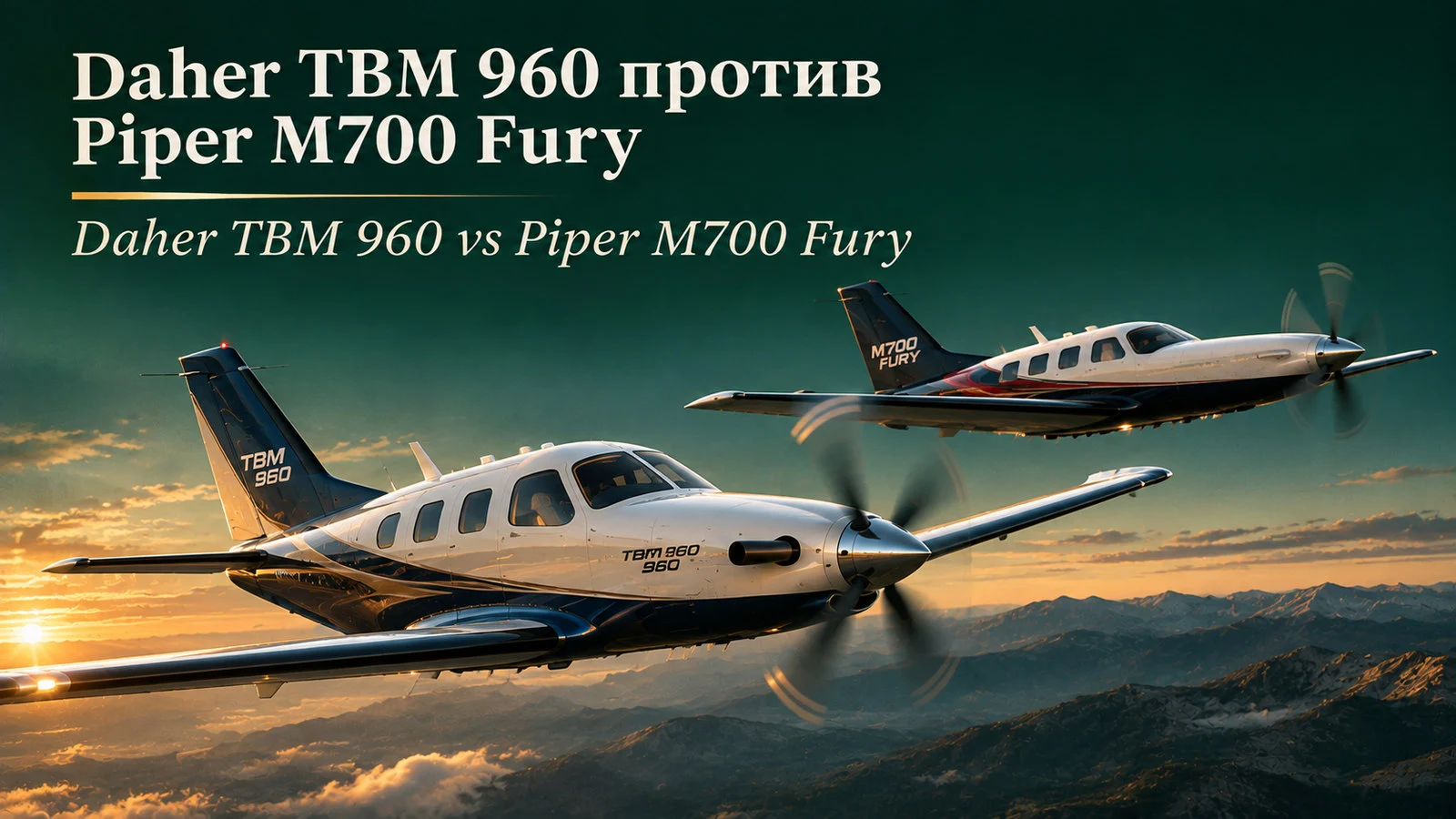
Piper launched the M700 Fury as the flagship of its line, and the aircraft landed squarely in a segment the TBM had dominated. Both seat six, both are single-engine with pressurised cabins, both are single-pilot certified. But their approach to the mission differs, and the delivery price gap is noticeable.
Range
Piper holds the paper advantage here. The M700 Fury is rated at 1,852 nautical miles, or 3,430 kilometres.
The TBM 960 is rated at 1,730 miles — 3,204 kilometres — at a long-range setting of 252 knots. At the recommended 290 knots it delivers 1,585 miles.
The gap in headline figures is around 120 miles in Piper’s favour, about seven percent. In practice that means somewhat more margin on marginal legs, but both aircraft cover the same route set: Tashkent–Dubai, Almaty–Istanbul, and internal legs across Central Asia.
As with any turboprop comparison, values must be matched at the same speed rather than taken as headline numbers. Manufacturers quote range in whichever regime flatters them.
Speed
Daher holds the advantage here. The TBM 960’s maximum cruise is 330 knots at 28,000 feet, with a recommended setting of 308 knots at 57 gallons per hour.
The M700 Fury shows around 301 knots. The gap to the TBM’s maximum is roughly 30 knots, about ten percent, which on a thousand-mile leg amounts to some twenty minutes.
The practical meaning. On short routes — hour-long internal legs across Uzbekistan or Kazakhstan — the difference barely registers. On long international legs it accumulates and starts to affect how a flying day is planned.
Price and what it buys
This is the pair’s key distinction. The TBM 960’s typical flyaway price runs around $4.5 million; the M700 Fury is positioned near $4.1 million.
A gap of several hundred thousand dollars — not dramatic but real. For it the TBM delivers greater speed, a longer market history and a larger operating fleet.
The M700 Fury offers greater quoted range in return, along with membership of the Piper line — which matters to an owner already operating the marque: a familiar service network, continuity in the flight deck, established procedures.
A separate factor for a Central Asian buyer is where the aircraft is maintained and how quickly a mobile team arrives on a fault. That question affects operations more than thirty knots of speed difference.
Model maturity and the pre-owned market
The TBM 960 was certified in 2022 and by 2025 more than 200 had been built. The TBM family has been in production since 1991, accumulated operating data is extensive and the pre-owned market is established.
The M700 Fury is a substantially newer model, succeeding the M600 and M600SLS. The operating fleet is smaller, the history shorter, and resale valuation so far less predictable.
For an owner with a long horizon this matters less; for one planning to change aircraft in three to five years, model maturity converts directly into residual value.
The status of hourly engine programmes is worth checking separately: active transferable coverage affects resale price more than aircraft age does.
What they share
Both are single-pilot certified and equipped with emergency autoland — HomeSafe on the TBM, an equivalent function on the Piper. For an owner-pilot this has become a baseline requirement.
Both are built on latest-generation Garmin avionics, both use Pratt & Whitney PT6 family engines, and both run on Jet A-1 — which settles the fuel availability question in Central Asia.
Both are designed for prepared aerodromes. If the flight profile includes unpaved strips, neither will cover the mission and a different class of aircraft is needed.
Who each aircraft suits
The TBM 960 makes sense where journey time on medium and long legs is the priority, where model maturity and predictable resale matter, and where Daher service support is available in the region of basing.
The M700 Fury makes sense where range on marginal legs matters, where the owner is already in the Piper ecosystem and values a single service network, and where the delivery price gap matters to the budget.
There is no universal answer: the aircraft are close in class and solve the same task with different emphases. The choice is more often settled by whose service support sits nearer your base than by specifications.
Summary
Quoted range: M700 Fury — 1,852 nautical miles; TBM 960 — 1,730 miles.
Maximum cruise speed: TBM 960 — 330 knots; M700 Fury — around 301 knots.
Typical flyaway price: TBM 960 — around $4.5 million; M700 Fury — around $4.1 million.
Maturity: the TBM 960 has been in production since 2022 with over 200 delivered; the M700 Fury is noticeably newer.
Shared: both seat six, single-pilot, run on Jet A-1, with emergency autoland and Garmin avionics.
Frequently asked questions
Which flies farther? On headline figures the M700 Fury — 1,852 miles against 1,730 for the TBM 960.
Which is faster? The TBM 960 — 330 knots maximum against around 301 for the M700 Fury.
Which is cheaper? The M700 Fury — around $4.1 million against roughly $4.5 million for the TBM 960.
Are both single-pilot? Yes, both are single-pilot certified with emergency autoland systems.
Can either operate from unpaved strips? Both are built for prepared surfaces; unpaved operation requires a different class of aircraft.
How to choose for your mission
The practical order: calculate the real legs and check whether maximum range is needed on even one of them. Then assess where each aircraft is maintained in your region. Only then compare specifications.
JetHunter supplies Daher and Piper into Kazakhstan and Uzbekistan. Tell us the routes and region of basing, and we will show whether the difference in specification delivers a practical effect on your legs or amounts to paying for an unused parameter.
«The M700 Fury is rated at 1,852 miles against the TBM’s 1,730 — but wins on range at a noticeably lower speed. The delivery price gap exceeds a million dollars, and the question becomes what you convert it into.»
— Alexey Mordvintsev, CEO of JetHunter
Author: Alexey Mordvintsev, CEO of JetHunter, President of the Association of Professionals of Executive Aviation Industry (APIDA). Over 14 years in the industry.