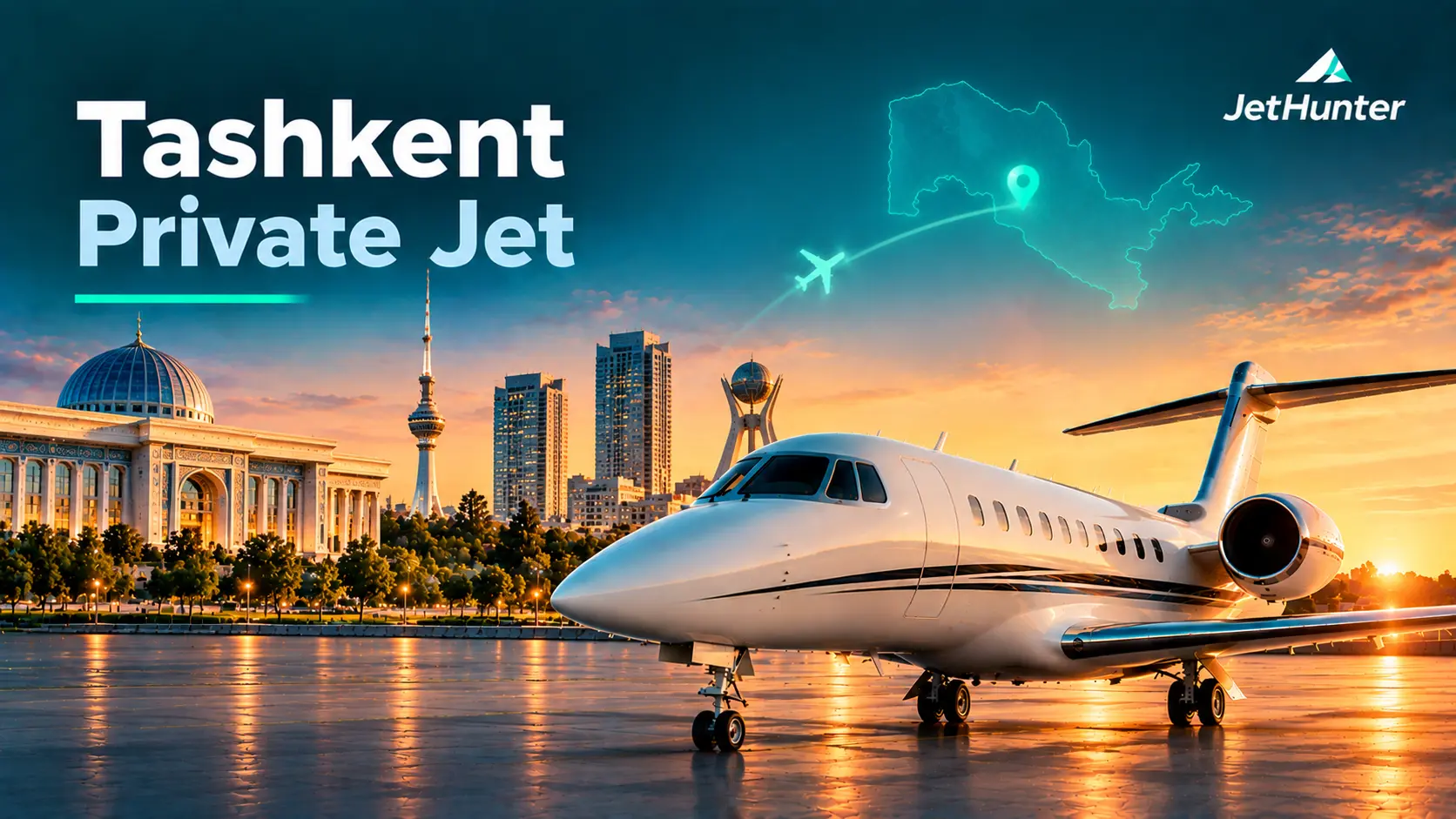
Tashkent is Uzbekistan's capital and business centre, and the main gateway into the country for international traffic. The distinguishing feature: infrastructure and demand are growing faster than the local business-aviation fleet, so most flights are operated by aircraft from neighbouring countries. Below: how that works in practice.
The airport
Tashkent Islam Karimov International Airport (TAS/UTTT) lies about 6 km from the city centre — unusually close for a capital airport, which noticeably cuts ground time. It is Uzbekistan's largest airport and the country's principal hub.
Other fields in the country: Samarkand (SKD/UTSS) with its 2022 terminal, Bukhara (BHK/UTSB), Urgench (UGC/UTNU) — the airport for Khiva — Namangan (NMA/UTFN), Fergana (FEG/UTFF). Domestic legs are short: about 40 minutes' flying to Samarkand, about an hour to Bukhara.
The regulator is the Civil Aviation Agency of Uzbekistan, registration prefix UK-. A landing permit for a foreign aircraft is arranged in advance through a ground agent, with several working days allowed for approval.
Where the aircraft come from
Uzbekistan has one operator with its own air operator certificate. The practical consequence: a flight is planned with the aircraft positioned from outside, and that positioning cost forms part of the quote. The main positioning points are Almaty (about 1 hour 20 minutes), Dubai (about 3 hours), Istanbul (about 4 hours 30 minutes) and Moscow (about 4 hours).
By comparison, Kazakhstan has 12 operators and the UAE a deep fleet available at short notice. So when planning a trip to Uzbekistan, the question of where the aircraft comes from is settled before which aircraft it will be — the positioning point drives both lead time and price.
International routes
Tashkent sits within a medium leg of the region's key markets: Dubai about 3 hours, Moscow about 4 hours, Istanbul about 4 hours 30 minutes, Delhi about 2 hours 30 minutes, Beijing about 5 hours 30 minutes.
These distances are covered by light and midsize jets. Direct arrivals from Western Europe need a midsize or heavy aircraft: London to Tashkent exceeds 5,500 km, Frankfurt about 4,900 km.
Why people fly to Tashkent
Two main flows. Business: Uzbekistan is opening its economy, the number of foreign investment and industrial projects is rising, and business trips into the regions are often easier by private aircraft because of the distances.
The second flow is tourism and transit: Tashkent serves as the entry point for Silk Road itineraries continuing to Samarkand, Bukhara and Khiva. Such a programme runs four to five days, and domestic flights shorten it by a day or two against ground logistics.
What to see
Tashkent is Central Asia's largest city, combining Soviet monumental architecture, eastern bazaars and modern business quarters. The main points: the Hazrati Imam complex holding one of the oldest Qur'an manuscripts, the Chorsu bazaar, Independence Square, and the Tashkent metro with its decorated stations.
The city usually serves as the start or end of an itinerary rather than a multi-day destination in itself. Hence the typical pattern: arrive in Tashkent, fly on to Samarkand and Bukhara, return to Tashkent to depart.
When to fly
The best windows are spring, April to May, and autumn, September to October: comfortable temperatures for the city and for sightseeing. Summer is hot; winter is cool and less busy, which makes ground handling easier to arrange.
Peak demand coincides with the tourist seasons and major business events. In these periods aircraft, parking and ground transfers are reserved ahead — bearing in mind the aircraft will most likely come from another country.
Practical planning
The order of operations differs from a European destination. First the positioning point is set and the repositioning cost calculated, then the landing permit is arranged through an agent, then parking for the duration of the visit is settled.
For a multi-leg programme with flights to Samarkand and Bukhara, the whole chain is planned together: permits for each aerodrome, parking at each point, ground transfers. Fuel for the return leg is confirmed in advance — availability at regional fields is lower than in Tashkent.
The airport: what matters
Tashkent's airport is the largest in Uzbekistan and among the oldest in Central Asia. Its location just a few kilometres from the centre is a notable operational advantage: the ground transfer takes minutes rather than the hours typical of capitals with out-of-town airports.
The flip side of a city location is noise limits and possible night restrictions, worth confirming for specific dates. Separate formalities procedures are provided for business aviation.
Domestic flights
Distances within the country are modest, and domestic legs are covered by light jets and turboprops: Samarkand about 40 minutes, Bukhara about an hour, Urgench about an hour, Fergana about 40 minutes.
It is on domestic legs that private aviation delivers the main saving: the road from Tashkent to Khiva takes more than a day, while the flight is about an hour. For business trips into the regions this is often the only way to fit a programme into a single day.
Who a private flight to Tashkent suits
The first scenario is business travel with trips into the regions: distances within the country are large and scheduled service between regional centres is limited. A private aircraft turns a three-day programme into one day.
The second is Silk Road itineraries, where Tashkent serves as the entry and exit point and Samarkand, Bukhara and Khiva are reached by domestic flights. The third is transit: the city sits conveniently on routes between Europe, the Middle East and Asia.
The fourth is family and group travel, where the absence of connections and the ability to carry baggage without scheduled-airline limits matter.
Frequently asked questions
Where will the aircraft come from? Most often Almaty, Dubai, Istanbul or Moscow — Uzbekistan has one registered operator, so positioning forms part of the quote.
How long do permits take? Several working days through a ground agent; for a multi-leg programme, permits are arranged for each aerodrome.
How far is the airport from the city? About 6 km from the centre — unusually close for a capital airport, with a ground transfer of minutes.
The Fergana Valley and the east
The eastern part of the country — Namangan (NMA/UTFN), Fergana (FEG/UTFF), Andijan — is separated from Tashkent by a mountain pass, so the road takes several hours and depends on weather. The flight takes about 40 minutes.
For business trips to the valley's industrial sites this is decisive: a programme that stretches to two days by road fits into one by air. The fields accept light and midsize aircraft; fuel and ground handling availability is confirmed in advance.
What to plan for
The destination's defining feature is that the approvals chain affects timing more than aircraft availability. Landing permit, parking, fuel and ground handling are arranged through an agent, and each step needs time.
For a multi-leg programme with flights to Samarkand, Bukhara and Urgench, permits are arranged separately for each aerodrome. Fuel availability at regional fields is lower than in Tashkent, so the return leg is calculated in advance.
A practical tip: plan the first day with margin. Arriving from another country, clearing formalities and taking a domestic flight the same day is feasible, but a delay at any link shifts the whole chain.
Choosing an aircraft
For Uzbek routes, sourcing starts from the positioning point: an aircraft from Almaty or Dubai costs less than one from Europe at comparable comfort. The class is set by the length of the positioning leg rather than by distances within the country, which are short.
JetHunter provides access to more than 5,000 aircraft and a catalogue of 246 models with range maps. For Uzbekistan, sourcing includes permits, parking and ground handling — on this destination the approvals chain affects timing more than aircraft availability does.
«Tashkent is the gateway to a country where infrastructure is growing faster than the local fleet. One registered operator against rising business traffic means simple arithmetic: the aircraft almost always comes from outside, and positioning is part of the quote.»
— Alexey Mordvintsev, CEO of JetHunter
Author: Alexey Mordvintsev, CEO of JetHunter, President of the Association of Professionals of Executive Aviation Industry (APIDA). Over 14 years in the industry.