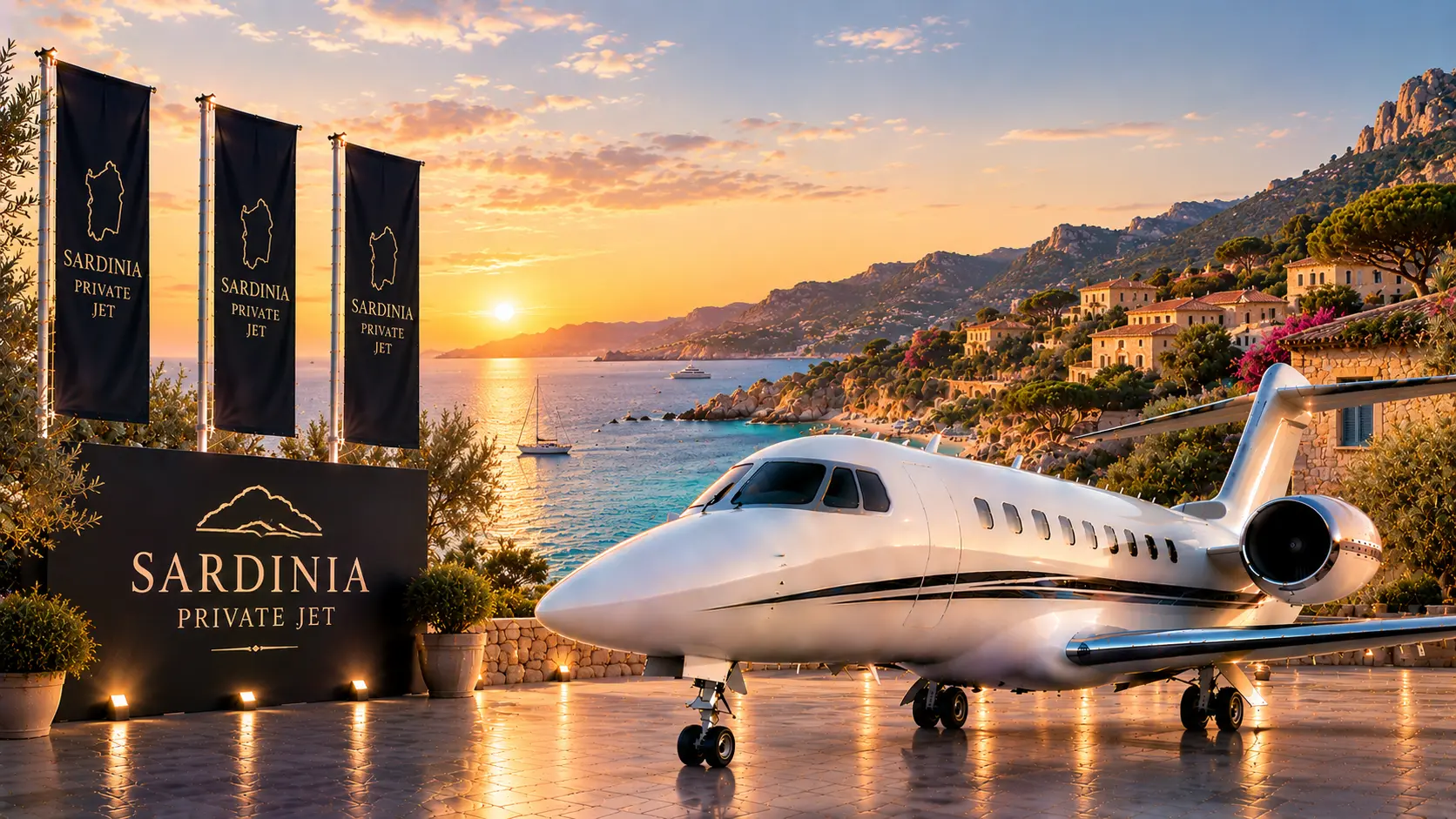
In summer Sardinia becomes one of the Mediterranean's busiest business-aviation hubs; in winter it nearly falls silent. The gap between seasons here is sharper than on any other European destination and drives the whole logic of planning. Below we cover the island's airports, August slot constraints and how a flight is actually arranged.
Olbia: gateway to the Costa Smeralda
Olbia Costa Smeralda (OLB/LIEO) is the main entry point to the northeastern coast, about 4 km from the centre of Olbia. The airport is operated by GEASAR, and a dedicated business-aviation terminal works here.
A single runway of 2,445 metres at an aerodrome elevation of just 11 metres accepts aircraft of every class, from turboprops to heavy and ultra-long-range jets. Annual traffic runs to roughly 28,000 movements, the overwhelming share of them in the summer months.
Operating hours are seasonal: in winter the airport works roughly 06:00 to 23:00 with night noise restrictions, switching to round-the-clock in summer. This matters when planning late arrivals in low season.
Slots: August's main constraint
In high season from May to September slots at Olbia are mandatory, and at peak availability compresses radically. By industry estimates, in the first two weeks of August the number of available inbound windows falls to fewer than four per hour in the morning.
The practical consequence: requests filed less than 48 hours before an intended departure may find no legal slot in the preferred window at all during peak. For August, planning starts weeks ahead, and the slot is agreed before the aircraft is sourced.
Alghero and Cagliari
Alghero-Fertilia (AHO/LIEA) lies in the island's northwest with a runway of about 3,000 metres, allowing heavy and long-range aircraft. It is less congested in season and serves as a sensible alternative when no Olbia slot is available.
Cagliari-Elmas (CAG/LIEE) serves the south and suits trips to Villasimius, Chia and the southern coast. The distance between Olbia and Cagliari is around 270 km — about three hours by road — so choosing the airport by final destination saves not minutes but half a day.
Routes and flight times
Sardinia is conveniently placed relative to European markets. Olbia to Nice is about an hour, Olbia to Milan around 1 hour 10 minutes, Olbia to Rome about 50 minutes, Olbia to Geneva around 1 hour 20 minutes, Olbia to London about 2 hours 20 minutes.
For longer routes: Moscow to Olbia is about 4 hours, Dubai to Olbia around 6 hours 30 minutes. European legs are covered by light and midsize jets, which makes Sardinia accessible for short weekend trips.
The Costa Smeralda and where people go
The northeastern coast — Porto Cervo, Cala di Volpe, San Pantaleo, Capriccioli — concentrates most of the yacht berths, hotels and premium villas. Olbia to Porto Cervo is around 30–40 minutes by car outside peak hours.
In summer the road is congested, and some guests use a helicopter transfer directly from the aircraft to the hotel, villa or yacht. Such transfers are arranged together with the flight: in August helicopters book out as tightly as aircraft.
Seasonality
The peak falls in July and August, with the high season running May to September. In these months the Costa Smeralda becomes one of the Mediterranean's busiest business-aviation destinations alongside Ibiza, Mykonos and the French Riviera.
From October to April the island empties sharply: some hotels and restaurants close, but the airport becomes fully available — slots are free, parking is no problem, a flight is arranged within hours. For those travelling on business rather than for the sea, low season is easier.
Parking
In August the apron at Olbia is full, and parking for several days is a separate task settled together with the slot. As a rule the aircraft is repositioned after dropping passengers and brought back for the departure date.
Repositioning points are Cagliari, Rome, Nice, Genoa or mainland Italy. The reposition is billed alongside the flight, and on short trips it can noticeably change the final quote, so the calculation is made in advance rather than after the fact.
Practical planning
For August the order is: slot and parking first, then the aircraft, then the ground transfer. For low season the usual order applies. The second question is which airport: Olbia for the Costa Smeralda, Alghero for the northwest, Cagliari for the south.
The third is aircraft class: Olbia accepts everything, so there are no type restrictions here and range and passenger count decide. The fourth is confirming the airport's operating hours for the specific dates, since night restrictions apply in winter.
Cost and seasonality
The price of a Sardinia flight depends heavily on the date. In July and August not only rates rise but the associated costs too: parking, ground handling, repositioning after drop-off. In low season the same routes cost noticeably less with the infrastructure fully available.
An additional factor is empty legs: in late August and early September, as the flow turns back toward Europe, the number of repositioning flights off the island rises. For a traveller flexible on dates that is the window with the best balance of price and availability.
Formalities and practice
Italy is in the Schengen area, so flights within it clear with minimal formalities. The country's civil aviation is regulated by ENAC; for arrivals from outside the area, customs and border control operate at Olbia and are available for all flights, including private ones.
Fuel and light maintenance are available at the airport, which settles the question of refuelling before the return leg. On a multi-day visit at peak it is worth confirming not only parking but service availability in advance: in summer the handling agents are stretched.
Who a Sardinia flight suits
The main scenario is a summer stay on the Costa Smeralda, where the aircraft connects to a yacht or villa by road or helicopter transfer. At peak, scheduled flights are sold out and timetables rarely match the dates of a vessel or house rental.
The second scenario is a short weekend trip from a European city: legs of an hour to ninety minutes make Sardinia accessible for two days. The third is business visits in low season, when the island empties, slots are free and the infrastructure works without constraints.
Beyond the coast
Sardinia is known for more than the Costa Smeralda. The island preserves nuraghi — Bronze Age megalithic towers, some inscribed on the UNESCO World Heritage list. The interior offers mountain landscapes and traditional villages strikingly different from the resort north.
The south, with Cagliari and the beaches of Villasimius and Chia, is less congested and noticeably cheaper than the north at comparable coastal quality. This is exactly why the airport should be chosen from the final destination: 270 km between Olbia and Cagliari becomes three hours of driving.
Frequently asked questions
Which airport is closest to Porto Cervo? Olbia — around 30–40 minutes by car outside peak hours.
Does Olbia accept heavy aircraft? Yes; the 2,445-metre runway suits every class, including ultra-long-range.
Why is August difficult? Slots are mandatory from May to September, and in the first two weeks of August fewer than four inbound windows remain per morning hour.
Does the airport operate at night? Round-the-clock in summer; in winter roughly 06:00 to 23:00 with night noise restrictions.
Choosing an aircraft for Sardinia
For European routes light and midsize jets suffice — the legs are short and Olbia's runway accepts these classes without restriction. Intercontinental arrivals require heavy aircraft, and here Olbia and Alghero are equally suitable on infrastructure.
JetHunter provides access to more than 5,000 aircraft and a catalogue of 246 models with range maps. For Sardinia, sourcing is done together with the slot and parking decision: in August it is these, not the availability of a suitable aircraft, that determine whether the flight happens on the required dates.
«Sardinia runs 270 kilometres north to south, and choosing the wrong airport adds not minutes but hours of driving. Here the airport is chosen by the final destination, not by the name of the island.»
— Alexey Mordvintsev, CEO of JetHunter
Author: Alexey Mordvintsev, CEO of JetHunter, President of the Association of Professionals of Executive Aviation Industry (APIDA). Over 14 years in the industry.