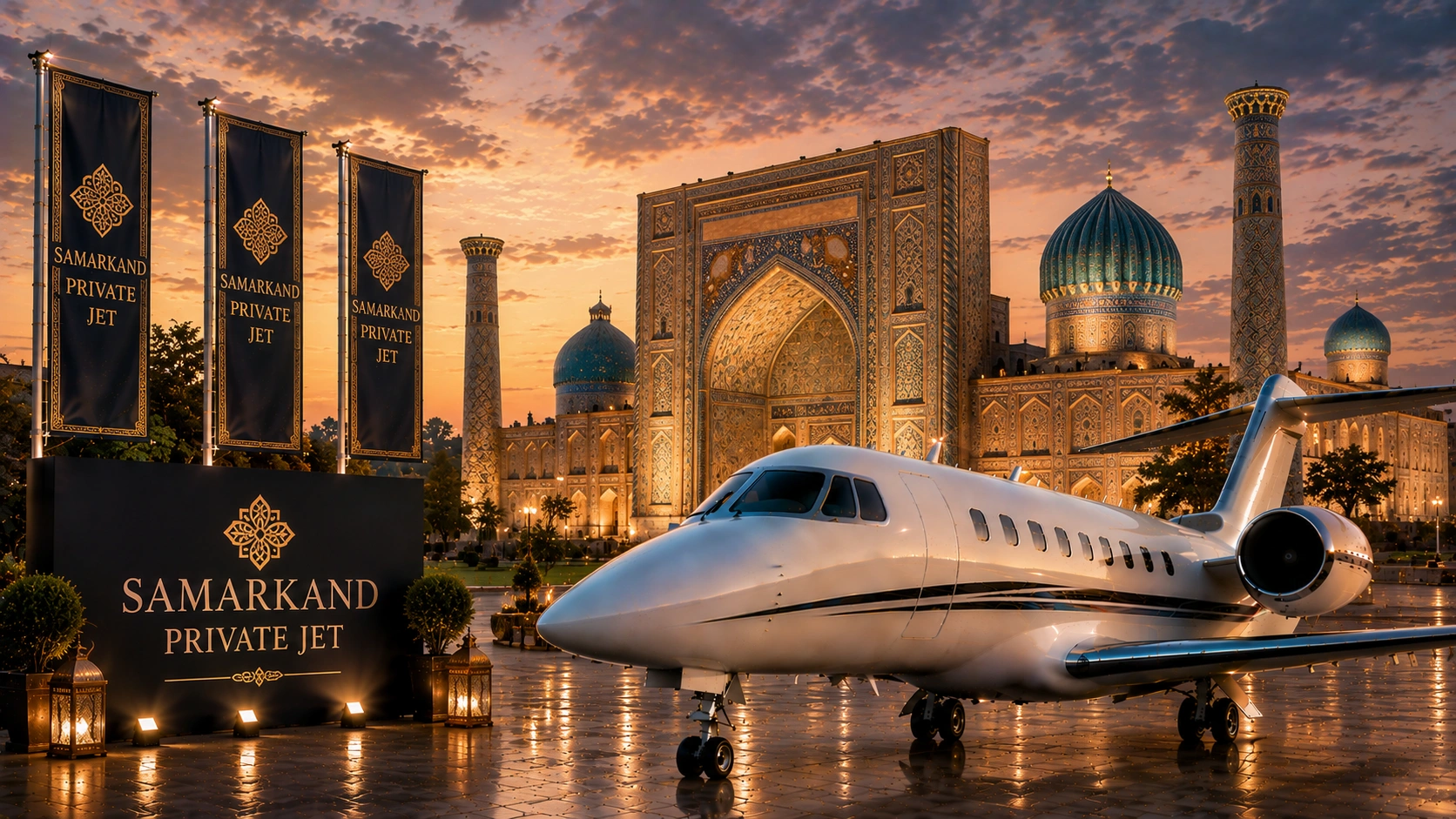
Samarkand is a rare case in Central Asia where the airport was rebuilt before demand grew. A new terminal, an open skies regime and the handling of international delegations have made the city accessible to private aviation without the permit and ground-handling difficulties typical of the region. Below: how the airport works, when to fly, which routes operate and what to plan for.
The airport: what changed after 2022
Samarkand International Airport (SKD/UTSS) sits on the city's northern edge. The new terminal opened on 18 March 2022 after a major reconstruction costing around $83 million; the building takes the form of an open book, a reference to the scientific legacy of Ulugh Beg.
Terminal capacity is up to 800 people an hour, allowing scheduled movements to rise from 40 to 120 a week. The terminal has a VIP hall and a business lounge. A practical detail: you can drive right up to the building, which is not enclosed by a fence — noticeably speeding up arrival for a private passenger.
The new terminal's operator is Air Marakanda, created under the first public-private partnership in Uzbek aviation. In 2025 it became the country's first aviation company to certify against three ISO standards — 9001, 14001 and 45001.
The open skies regime
The key change for accessibility: an open skies regime was introduced at Samarkand airport on 1 October 2022. In that year alone nine new airlines began serving Samarkand, five of them foreign.
For business aviation this means a simpler approvals process than under restricted regimes: access for foreign aircraft is broader, and competition holds down ground handling costs. A landing permit is still arranged in advance through a local agent.
Traffic and momentum
The figures show steady growth. In 2023 the airport handled 1.01 million passengers, 918,500 of them international — up 106.4% year on year. In the first half of 2025 it handled 5,577 movements (+4.9%) and 708,000 passengers (+9.4%), of whom 678,000 were on international routes.
For 2024 the airport ranked second for passenger growth in its category per ACI EUROPE, and the new terminal has placed in the top ten regional airports in Central Asia in the SKYTRAX rankings for three consecutive years.
The route network keeps widening: 2025 saw new services to Krasnoyarsk, Vladivostok, Dushanbe and Khabarovsk, and resumed flights to Baku, Turkestan and Urgench. The airport serves 23 destinations in total.
Handling delegations
The infrastructure passed a telling test in 2025, when the city hosted the 43rd session of the UNESCO General Assembly. The airport handled around 55 charter flights for the event, requiring protocol coordination and simultaneous parking for official delegation aircraft.
For a private client this is a practical signal: the airport can work with a flow of business aircraft, not only scheduled tourist traffic. But during major events parking and slots are allocated in advance — trips on those dates need planning with margin.
Routes and flight times
Samarkand lies within short and medium legs of the region's main markets. Tashkent is about 40 minutes' flying, Almaty about 1 hour 40 minutes, Dubai about 3 hours, Moscow about 4 hours, Istanbul about 4 hours 30 minutes.
These distances are covered by light and midsize jets such as the Embraer Phenom 300EV or Cessna Citation Latitude. Direct arrivals from Western Europe need a midsize or heavy aircraft: London to Samarkand exceeds 5,500 km.
What to see
Samarkand is one of the world's oldest cities and a hub of the Silk Road. The core of any programme: Registan Square with its three madrasahs, the Gur-e-Amir mausoleum holding Tamerlane's tomb, the Shah-i-Zinda necropolis, the Bibi-Khanym mosque and Ulugh Beg's observatory.
The compact historic centre allows the main programme to fit into two days. Itineraries often link Samarkand with Bukhara and Khiva — Bukhara is about 40 minutes' flying or roughly an hour and a half by high-speed train, Urgench (the airport for Khiva) about an hour by air.
When to fly
The best seasons are spring, April to May, and autumn, September to October: comfortable temperatures for open-air sightseeing. Summers in Samarkand are hot and daytime excursions demanding; winters are cool but tourist volumes are lower and ground handling more available.
Peak demand falls in the spring and autumn windows and around major events. In these periods aircraft parking and ground transfers are reserved ahead, especially if the trip includes onward flights to Bukhara or Urgench.
Practical planning
A landing permit for a foreign aircraft is arranged through a local agent, with several working days allowed for approval. The agent also meets the aircraft and coordinates formalities — standard practice for Uzbekistan and not a step to skip.
The second question is parking. On visits longer than two or three days the aircraft is often repositioned to Tashkent and brought back for departure; that repositioning is billed and planned in advance. The third is fuel for the return leg: availability and price are confirmed before departure.
Ground handling and formalities
Private aircraft at Samarkand have access to a VIP hall and business lounge, with formalities arranged through a ground agent. The absence of a perimeter fence and the ability to drive up to the terminal cut the path from car to aircraft to a few minutes — a rare combination at a regional airport.
The operator's certification to ISO 9001, 14001 and 45001 is a practical marker of process quality: the first such case in Uzbek civil aviation. For a client it means predictable ground handling, which the region does not always offer.
The Silk Road itinerary
Samarkand is rarely the only stop on a trip. A typical programme links three cities: Samarkand, Bukhara and Khiva. Samarkand to Bukhara is about 40 minutes by air or roughly an hour and a half by high-speed train; Urgench, the airport for Khiva, is about an hour by air.
When planning such a chain, permits are arranged separately for each aerodrome and parking reserved at each point. Fuel availability at regional fields is lower than at Tashkent and Samarkand, so the return leg is calculated in advance.
Who a Samarkand trip suits
The first scenario is business: Uzbekistan is opening its economy, and trips by investors and industrial delegations often cover several cities in two or three days. The scheduled network cannot deliver such a programme, and ground logistics between cities consume half a day at a time.
The second is premium cultural travel: a Silk Road itinerary with boutique hotels in the historic centre. The third is events: the city hosts international forums and sessions, and on those dates a private aircraft becomes the only way to arrive on your own schedule.
The fourth is transit. Samarkand lies between Europe, the Middle East and Asia, and a technical stop here can be combined with a one-day visit. The open skies regime and new infrastructure make such a stop markedly easier than five years ago.
Frequently asked questions
Is a landing permit required? Yes, it is mandatory for a foreign aircraft and arranged through a ground agent, with several working days allowed for approval.
Can you fly direct from Europe? Yes, with an aircraft of 6,000 km range or more — London and Frankfurt are within reach of midsize and heavy jets. From Dubai, Almaty and Istanbul a light or midsize aircraft suffices.
Where does the aircraft park during the visit? On a short visit, at Samarkand; on a longer one it is more economical to reposition it to Tashkent and bring it back for departure, with that repositioning built into the quote in advance.
Bukhara and Khiva
Bukhara (BHK/UTSB) is the country's second historic centre: the Poi-Kalyan ensemble, the Ark fortress, the trading domes. The airport accepts light and midsize aircraft; the flight from Samarkand takes about 40 minutes against roughly an hour and a half by high-speed train.
Khiva is served by Urgench airport (UGC/UTNU), 35 km from the town. It is the most remote point on the classic itinerary: the road from Samarkand takes more than ten hours, while the flight is about an hour. It is on this leg that private aviation saves the most time.
Choosing an aircraft for Samarkand
The sourcing order is the usual one: range from the departure point first, then passenger count, then configuration. Regional legs from Tashkent, Almaty or Dubai are served by a light or midsize jet; direct arrivals from Europe need range of 6,000 km or more.
JetHunter provides access to more than 5,000 aircraft and maintains a catalogue of 246 models with range maps. For Uzbek destinations, sourcing covers not only the aircraft but permits, parking and ground handling — a chain where a delay at one link shifts the whole trip.
«In four years Samarkand covered ground that takes other cities twenty: a new terminal, an open skies regime and hosting UNESCO-level delegations. For business aviation this is the rare case where infrastructure runs ahead of demand rather than chasing it.»
— Alexey Mordvintsev, CEO of JetHunter
Author: Alexey Mordvintsev, CEO of JetHunter, President of the Association of Professionals of Executive Aviation Industry (APIDA). Over 14 years in the industry.