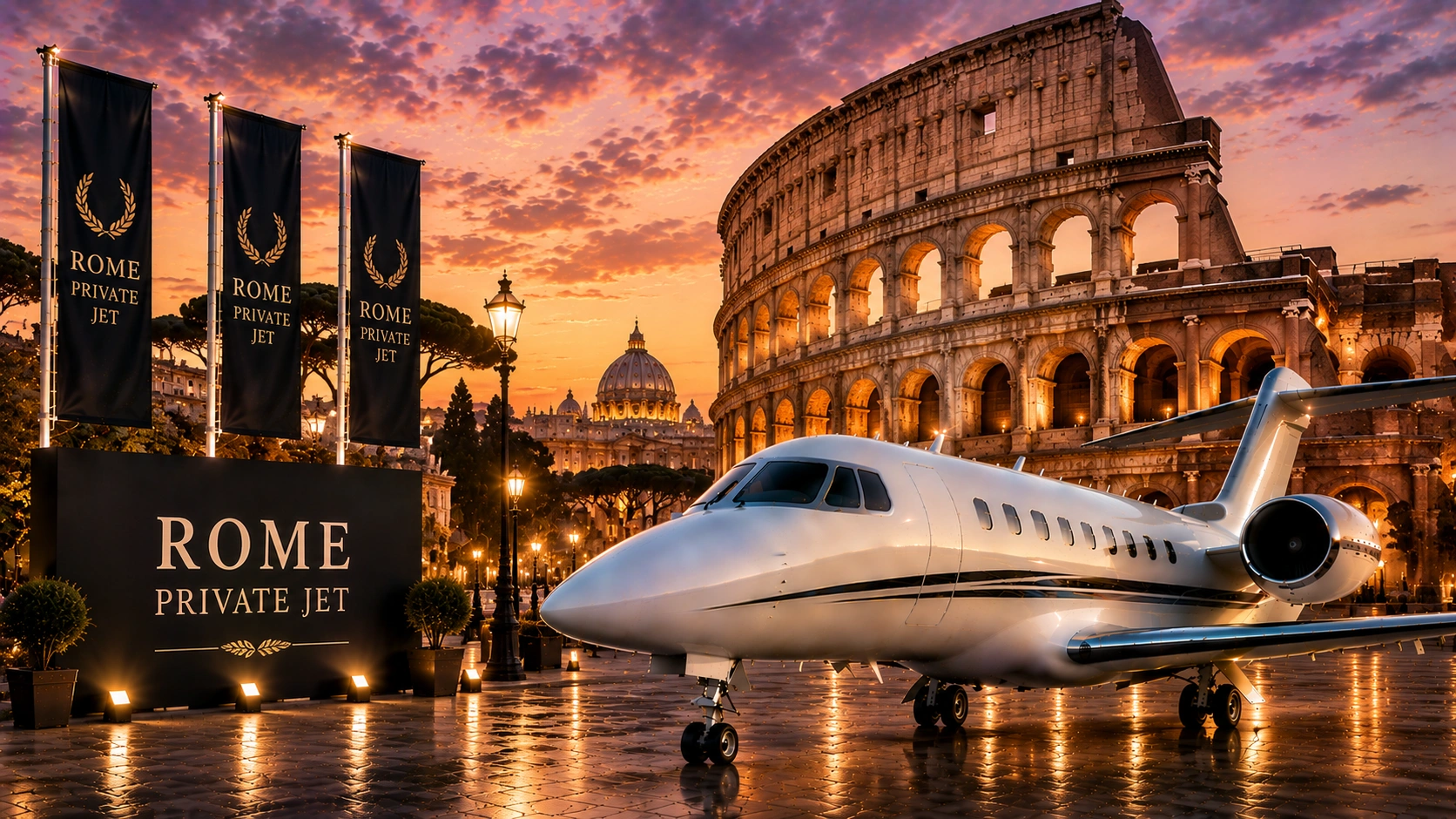
Rome ranks among Europe's top ten business-aviation destinations, and the traffic pattern here is distinctive: the main flow goes not through the primary international hub but through compact Ciampino inside the metropolitan area. Below we cover both airports, aircraft-type constraints, routes, seasons and practical planning.
Ciampino: the business-aviation airport
Rome Ciampino (CIA/LIRA) is the capital's historic airport, about 12 km southeast of the centre. It specialises in business aviation and low-cost carriers, and per European Business Aviation Association data it ranks among Europe's ten busiest business airports.
Ciampino's advantage is proximity: 25–35 minutes by car to the historic centre on a clear road. Its constraint is runway length: shorter than Fiumicino's, and heavy aircraft at full payload cannot always use it. That is settled at the aircraft-selection stage, not on the day of departure.
The second constraint is operating hours: Ciampino has night restrictions and movement caps, imposed because of the dense residential development around the airport. A late arrival or early departure is checked against these in advance.
Fiumicino and Urbe
Rome Fiumicino (FCO/LIRF) is Italy's main international hub, roughly 30 km southwest of the city. Business aviation uses it in three cases: the aircraft is too large for Ciampino, a connection to a scheduled flight is needed, or no slot or parking is available at Ciampino on the required dates.
A third field is Roma-Urbe (LIRU), a small aerodrome north of the city. It handles light aircraft and helicopters and suits short regional legs, but is unsuitable for most international flights on runway length and services.
Routes and flight times
Rome sits at the centre of the Mediterranean network, and the legs from here are short. Ciampino to Milan Linate remains one of Europe's busiest domestic business-aviation routes, at about an hour's flying. Rome to Nice is around 1 hour 20 minutes, Rome to Paris about 1 hour 50 minutes, Rome to London about 2 hours 20 minutes.
For longer routes: Moscow to Rome is about 3 hours 40 minutes, Dubai to Rome around 6 hours. European legs are covered by light and midsize jets; intercontinental ones need heavy aircraft — and the airport choice then shifts automatically toward Fiumicino.
Seasons and events
Rome is busy year-round, but the peaks are pronounced. Spring from April to June and autumn from September to October bring the best sightseeing weather and the heaviest tourist flow. Summer is hot and some Romans leave the city, but visitor numbers do not fall.
A separate factor is the religious calendar: Easter, Christmas and special Vatican events sharply increase load on airports and ground logistics. On those dates aircraft, slots and transfers are booked well ahead rather than days in advance.
What to see
Rome is a city where antiquity and baroque share a street: the Colosseum and Roman Forum, the Pantheon, the Trevi Fountain, the Spanish Steps, Villa Borghese. A separate state within the city is the Vatican, with St Peter's Basilica and the museums including the Sistine Chapel.
For a business traveller the centre is compact: most key points are within walking distance of one another, allowing a work programme to be combined with sightseeing without losing time to travel across the city.
Rome as a base for Italy
Short legs from Rome reach every key point in the country: Milan about an hour, Venice around 50 minutes, Naples about 40 minutes, Sicily and Sardinia a little over an hour. That makes the capital a convenient entry point for a multi-city programme.
Summer adds resort destinations: Olbia in Sardinia and the Amalfi Coast airports via Naples. In peak season slot restrictions apply there, so such combinations are planned as a whole and in advance rather than piecemeal.
Parking and repositioning
On visits longer than a few days, parking is handled separately. Apron space at Ciampino is limited, and the aircraft is often repositioned to another field — Fiumicino, Naples or Florence — returning for the departure date.
The reposition is billed alongside the flight and built into the quote in advance. On short two- or three-day visits the aircraft usually stays put and the cost does not arise — the calculation is made against specific dates.
Practical planning
The first question is which airport. If the aircraft is midsize or light and ground time is the priority, Ciampino. If the aircraft is heavy, long parking is needed, or no Ciampino slot exists — Fiumicino plus an extra 20–30 minutes of road time.
The second factor is traffic: at peak hours the drive from Ciampino into the centre can take considerably longer than planned, so a meeting is better not scheduled tight against arrival. The third is Ciampino's operating hours: night restrictions are checked when the schedule is agreed.
Cost and what drives the price
The cost of a Rome flight is set by aircraft class, leg distance and the chosen airport. Fees at Fiumicino are higher than at Ciampino, but with a heavy aircraft there is no choice. Ground handling, parking, catering and, on multi-day visits, repositioning are added to the flight hours.
Season affects it directly: on peak dates not only demand for aircraft rises but also the cost of parking and ground services. For those flexible on dates, empty legs are an option — Rome is linked by a dense flow of repositioning to Milan, Nice and Paris, producing regular offers.
Helicopter transfers
For destinations beyond the city a helicopter is often more efficient than a car: the Amalfi Coast, Tuscany or the lakes take hours by road but tens of minutes by air. The transfer is arranged directly from the aircraft at the airport.
Within Rome itself helicopters are used less: the centre is compact and there are no landing sites in the historic core. The practical conclusion: a helicopter makes sense when the final destination is out of town, and does not when the programme sits entirely within the centre.
Who a Rome flight suits
The first scenario is a single-day business visit: arrive at Ciampino in the morning, meetings in the centre, evening departure. The city's compactness and the airport's proximity make such a programme working routine, where a scheduled flight would require an overnight.
The second is a multi-city Italian programme with Rome as the entry point and short onward legs to Milan, Venice or the coast. The third is family or group travel, where the aircraft cost is shared and the absence of connections and queues matters more than the ticket price.
Formalities
Italy is in the Schengen area, so formalities on flights within it are minimal, making European routes especially quick. Arrivals from outside the area clear customs and border control, but in separate facilities and without shared queues.
The operator requests a passenger list with passport details in advance — it is needed for filing the flight plan and advance notification. This means adding a passenger at the last minute runs into paperwork, not into free cabin seats.
Frequently asked questions
Which airport is closer to the centre? Ciampino — about 12 km and 25–35 minutes by car against 30 km and roughly an hour from Fiumicino at peak.
Why not always fly into Ciampino? Its runway is shorter and heavy aircraft at full payload cannot always use it; night restrictions and movement caps also apply.
How long is the flight from Moscow? About 3 hours 40 minutes; from Dubai around 6 hours, from Milan about an hour.
Is advance booking needed? Outside peaks a flight is arranged within hours; for Easter, Christmas and major Vatican events, weeks ahead.
Choosing an aircraft for Rome
The sourcing order for Rome is unusual: first the aircraft class is set by route and passenger count, and that class then dictates the airport rather than the other way round. European legs suit light and midsize jets, which Ciampino accepts; intercontinental arrivals mean Fiumicino.
JetHunter provides access to more than 5,000 aircraft and a catalogue of 246 models with range maps. Sourcing accounts for the specific airport's constraints — runway length, operating hours and parking availability on the required dates, not the route alone.
«Rome is a rare case where the airport choice is decided not by travel time but by aircraft class. Ciampino is closer and more convenient, but its runway is shorter, and a heavy jet at full payload simply cannot land there.»
— Alexey Mordvintsev, CEO of JetHunter
Author: Alexey Mordvintsev, CEO of JetHunter, President of the Association of Professionals of Executive Aviation Industry (APIDA). Over 14 years in the industry.