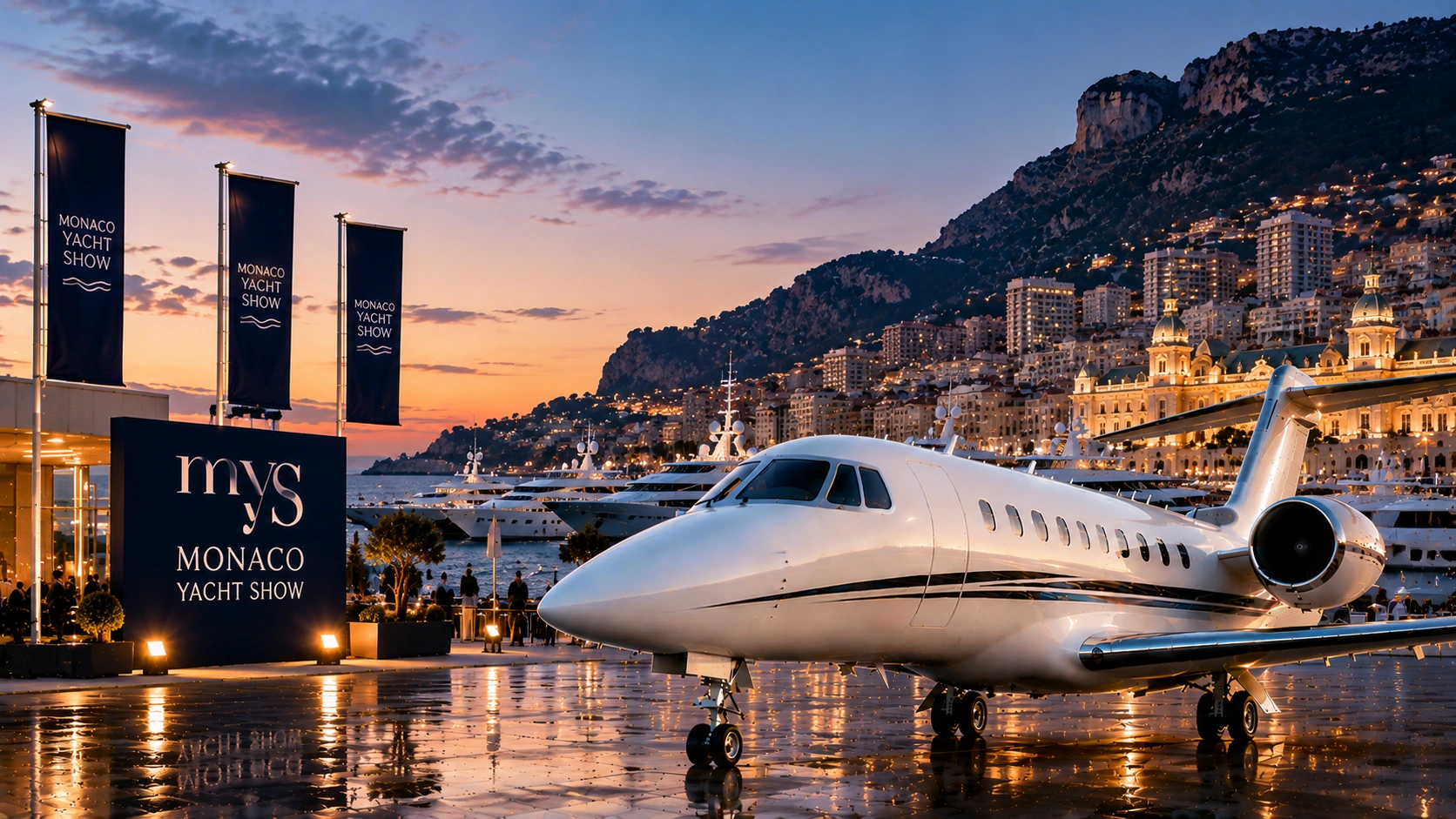
The Monaco Yacht Show in late September closes the Mediterranean yachting season and creates the final load peak on Riviera business aviation. What distinguishes the destination is that Monaco has no airport of its own, so the journey is always two-stage. Below we cover the logistics from arrival to Port Hercule.
Monaco without an airport
The principality covers about two square kilometres, and there is physically no room for an airport. Its only aviation facility is the Monaco heliport (LNMC), which handles transfers rather than standalone flights.
The main gateway is therefore Nice Côte d'Azur (NCE/LFMN), some 20–30 kilometres to the west. The airport operates around the clock, accepts every aircraft class and has a dedicated terminal for private flights.
The coast road from Nice to Monaco takes around an hour on a normal day, but during show days the coast is congested and the time grows unpredictably. This is exactly why a helicopter transfer here is standard rather than a premium option.
The helicopter as the norm
The flight from Nice airport to the Monaco heliport takes minutes against an hour or more by road. During show days that is a difference not in comfort but in whether scheduled meetings happen at all.
Helicopters in late September book out as tightly as aircraft, so the transfer is arranged together with the main flight rather than after arrival. A separate scenario is delivery directly to a vessel, where guests stay on a yacht rather than in a hotel.
The September peak
The Monaco Yacht Show runs in late September and gathers vessel owners, brokers, shipyards and industry suppliers. It is the last major event of the Mediterranean season, and demand for aircraft, slots and parking on those days matches the summer peaks.
What makes September distinctive is a simultaneous reverse flow: the season on the coast and the islands is ending and aircraft return to European bases. For those flexible on dates, that raises the chance of finding an empty leg departing the region.
Parking and repositioning
The apron in Nice is full during show days, and after dropping passengers the aircraft is repositioned to another field, returning for the departure date. Typical repositioning points are Marseille, Genoa, Olbia and mainland Italy.
The reposition is billed alongside the flight and on a short three- or four-day trip forms a noticeable share of the quote. Parking must be agreed together with the slot, not after the aircraft is confirmed.
Routes and flight times
Nice is linked by short legs to all of Europe: London to Nice is about 2 hours, Paris to Nice around 1 hour 20 minutes, Geneva to Nice about an hour, Milan to Nice around 45 minutes, Munich to Nice about 1 hour 20 minutes.
For longer routes: Moscow to Nice is about 3 hours 40 minutes, Dubai to Nice around 6 hours 30 minutes. Guests from the Gulf and North America arrive on heavy and ultra-long-range aircraft, for which Nice remains the region's only option.
What makes Monaco distinctive
The principality is compact: Port Hercule, where the show takes place, the Monte Carlo casino, the hotels and restaurants are all within walking distance of one another. That simplifies the programme — once arrived, movement within the territory is minimal.
Monaco is not in the European Union but is linked to French territory under a special arrangement, and helicopter transfers from Nice raise no practical difficulty. Formalities are cleared in Nice on arrival.
Who a private flight suits
The first scenario is industry participants: vessel owners, brokers and shipyard representatives, for whom the show is a dense calendar of meetings over several days. The second is guests combining the show with a yachting programme on the coast.
The third is those coming for a few hours: arrive in the morning, meetings during the day, evening departure. Monaco's compactness and Nice's proximity make that format realistic, where scheduled flights would require two overnights.
Combining with a yachting programme
A significant share of show guests come for more than the exhibition: September closes the Mediterranean season, and the trip often combines with a vessel's last outing or its post-season handover. That changes the route structure.
The typical arrangement is arrival in Nice, helicopter to Monaco for the show days, then a flight to the vessel's mooring point: Olbia, Palma, Genoa. Such combinations are agreed as a whole in advance, since a slot at one airport affects the ability to depart for the next.
Frequently asked questions
Is there an airport in Monaco? No, only the LNMC heliport for transfers. The main gateway is Nice, 20–30 km away.
How long is the helicopter transfer? Minutes, against an hour or more by road during show days.
Are separate formalities needed for Monaco? No: control is cleared in Nice on arrival, and the principality is linked to French territory under a special arrangement.
When does the show run? Late September; it is the last major peak of the Mediterranean season.
Choosing an aircraft and planning the route
The September order: slot and parking in Nice first, then the helicopter transfer, then the aircraft. Aircraft class is not a constraint — Nice accepts everything, so range from the departure point and passenger count decide.
JetHunter provides access to more than 5,000 aircraft and works with Riviera event routing. For the Monaco Yacht Show the whole chain — slot, parking, repositioning, helicopter — is agreed simultaneously, because in late September every link becomes scarce.
«Monaco is a state without an airport, and that defines the whole logistics. The aircraft lands in Nice and a helicopter covers the last twenty kilometres: during show days that is several times faster than the coast road.»
— Alexey Mordvintsev, CEO of JetHunter
Author: Alexey Mordvintsev, CEO of JetHunter, President of the Association of Professionals of Executive Aviation Industry (APIDA). Over 14 years in the industry.