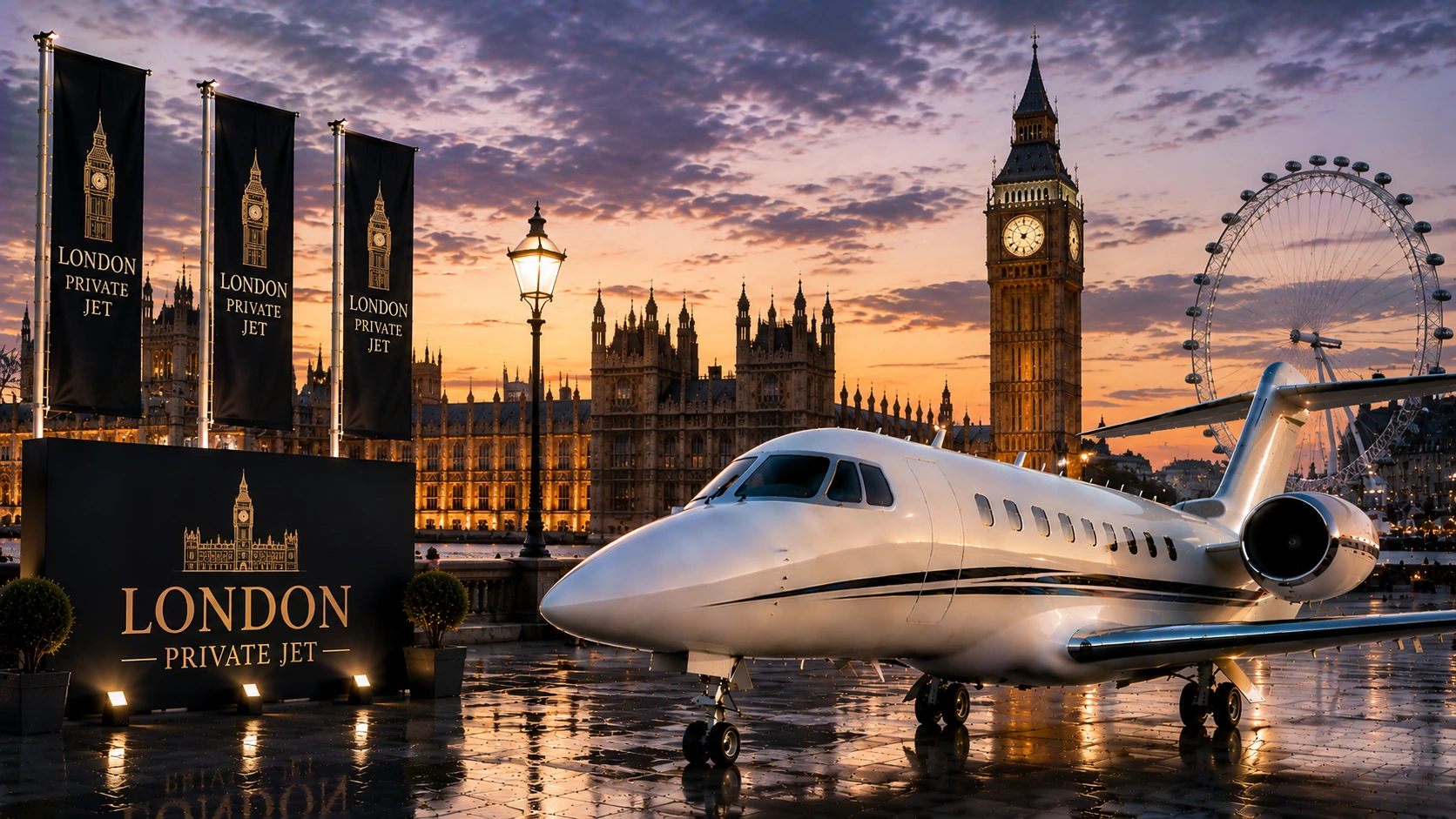
London is Europe's largest business-aviation market by number of airports serving private flights: there are six, and three rank among the continent's ten busiest business airports. The choice between them determines how long the journey to the final destination takes. Below we cover every field, their strengths, technical constraints and post-Brexit formalities.
Farnborough: business aviation only
Farnborough (FAB/EGLF) lies southwest of London and is dedicated entirely to business aviation — there are no scheduled services. Per European Business Aviation Association data it ranks among Europe's five busiest business airports.
The practical consequence of that specialisation is no competition for slots with airlines and a high standard of ground handling. Farnborough suits destinations west and southwest of the capital, including Surrey and the Thames Valley.
Luton and Biggin Hill
Luton (LTN/EGGW) is about 50 km north of London and handles both scheduled and private flights. It is the UK's busiest field for private departures, giving maximum flexibility on slots and aircraft availability. Luton suits destinations north and into the Midlands.
Biggin Hill (BQH/EGKB) lies southeast of the city and specialises in business aviation. It suits Kent and south London. Both fields rank among Europe's ten busiest business airports, so on peak dates slots here also need early booking.
London City: closest, but not for every aircraft
London City (LCY/EGLC) sits in the Docklands and is closest to the City and Canary Wharf. But it carries a technical constraint worth knowing in advance: the approach path is 5.5 degrees against a standard 3 degrees because of the surrounding buildings.
The practical consequence: only specifically certified aircraft types with qualified crews are cleared to use it. That noticeably narrows the choice of aircraft, and the qualification is verified before an aircraft is offered to the client, not after the flight is confirmed.
Stansted and Northolt
Stansted (STN/EGSS) northeast of London is used as an alternative when the primary fields are unavailable and accepts aircraft of all classes without type restrictions.
Northolt (NHT/EGWU) is a Royal Air Force station permitting a limited number of civil business flights under specific arrangements. It is close to the centre but access is restricted and requires arrangement in advance, so it is used when proximity matters more than flexibility and dates are known well ahead.
Routes and flight times
London to Paris remains one of Europe's busiest business-aviation city pairs, at about an hour's flying. London to Geneva is around 1 hour 30 minutes, London to Nice about 2 hours, London to Milan about 1 hour 50 minutes.
For longer routes: Moscow to London is about 4 hours, Dubai to London around 7 hours, New York to London about 7 hours. European legs are covered by light and midsize jets; transatlantic ones require heavy and ultra-long-range aircraft.
Formalities after Brexit
The United Kingdom is in neither the European Union nor the Schengen area, and that changes procedures even for business aviation. A valid passport is required — an identity card is insufficient for most travellers — and every arriving passenger clears border control, albeit in a separate terminal.
The passenger list is filed in advance, which makes adding someone at the last minute harder than it seems: the constraint is paperwork, not cabin seats. Pets are subject to separate requirements: microchip, rabies vaccination, health certificate and entry only through approved points.
Seasons and events
London is busy year-round as a financial centre, but events create peaks: Wimbledon in June and July, Royal Ascot, Fashion Weeks in February and September, major exhibitions and conferences. On those dates both slots and parking come under pressure.
Summer adds leisure traffic; winter stays predominantly business-driven. Outside the peaks London is flexible: an aircraft can be arranged at short notice thanks to the number of fields and the high concentration of operators in the region.
Parking and basing
On a longer visit parking is settled in advance: on peak dates space is limited at all the main fields, and the aircraft is often repositioned and brought back for departure. That reposition is billed and planned together with the flight.
For those flying to Europe regularly, the London fields often become a base: developed infrastructure, hangars and maintenance allow the aircraft to sit here between trips, cutting repositioning and making subsequent journeys cheaper.
Cost and how the invoice is built
The cost of a London flight combines flight hours, airport and handling fees, crew duty, parking and catering. Fees differ between fields: Farnborough and London City are traditionally more expensive than Luton and Stansted for comparable flight time.
Where the aircraft comes from also matters: if a suitable aircraft is based in London there is no repositioning; if it must be brought from Europe, that is a separate line. This is why a request with exact dates and destination address yields a better price than an abstract enquiry for 'a flight to London'.
Empty legs
Traffic density makes London one of the most promising destinations for finding empty legs within Europe. Aircraft arrive from Paris, Geneva, Nice and Milan and often return empty, creating a steady flow of offers.
The conditions are the same as everywhere: departure airport, route and timing are set by the aircraft's primary schedule and cannot be changed, and the decision must be made quickly. With date flexibility and willingness to depart from any of the six fields, the chance of catching a suitable flight here is above the continental average.
Who a London flight suits
The main scenario is a business trip to the financial centre on a tight schedule: arrive in the morning, meetings, evening return. Short European legs and six fields to choose from make a single-day visit realistic even on a dense timetable.
The second is events: Wimbledon, Royal Ascot, Fashion Weeks, major conferences, when scheduled flights are sold out and timetables do not match the programme. The third is transatlantic routing, where London serves as the European entry point for aircraft from North America.
Ground transfer and helicopters
Distance to the centre is deceptive with the London fields: Luton is 50 km away, but the M1 can make the journey shorter than from Biggin Hill at peak. That is why the criterion is transfer time to a specific address, not kilometres to Trafalgar Square.
For compressed schedules a helicopter transfer is used: it removes dependence on traffic and cuts the journey to minutes. Such transfers are arranged together with the flight, since on peak dates helicopters book out as tightly as aircraft.
Frequently asked questions
Which airport should I choose? Farnborough for the west and Surrey, Luton for the north, Biggin Hill for Kent, London City for the City and Canary Wharf where the aircraft is cleared.
Why can't every aircraft use London City? The 5.5-degree approach against a standard 3 degrees requires specific type certification and crew training.
Is a passport needed after Brexit? Yes; an identity card is insufficient for most travellers, and every arriving passenger clears border control.
How long is the flight from Moscow? About 4 hours; from Dubai around 7 hours, from Paris about an hour.
How to choose the airport and aircraft
The key criterion is not distance to the centre but ground transfer time to the final destination. Farnborough for the west and Surrey, Luton for the north and Midlands, Biggin Hill for Kent, London City for the City and Canary Wharf where the aircraft is cleared.
JetHunter provides access to more than 5,000 aircraft and selects one accounting for clearance at the specific field — including London City certification — while coordinating slots, parking and ground transfer to the destination address rather than simply 'to London'.
«London has six business-aviation airports, and the choice between them is made not by distance to the centre but by ground transfer time to a specific address. Those are different things, and the gap runs to an hour.»
— Alexey Mordvintsev, CEO of JetHunter
Author: Alexey Mordvintsev, CEO of JetHunter, President of the Association of Professionals of Executive Aviation Industry (APIDA). Over 14 years in the industry.