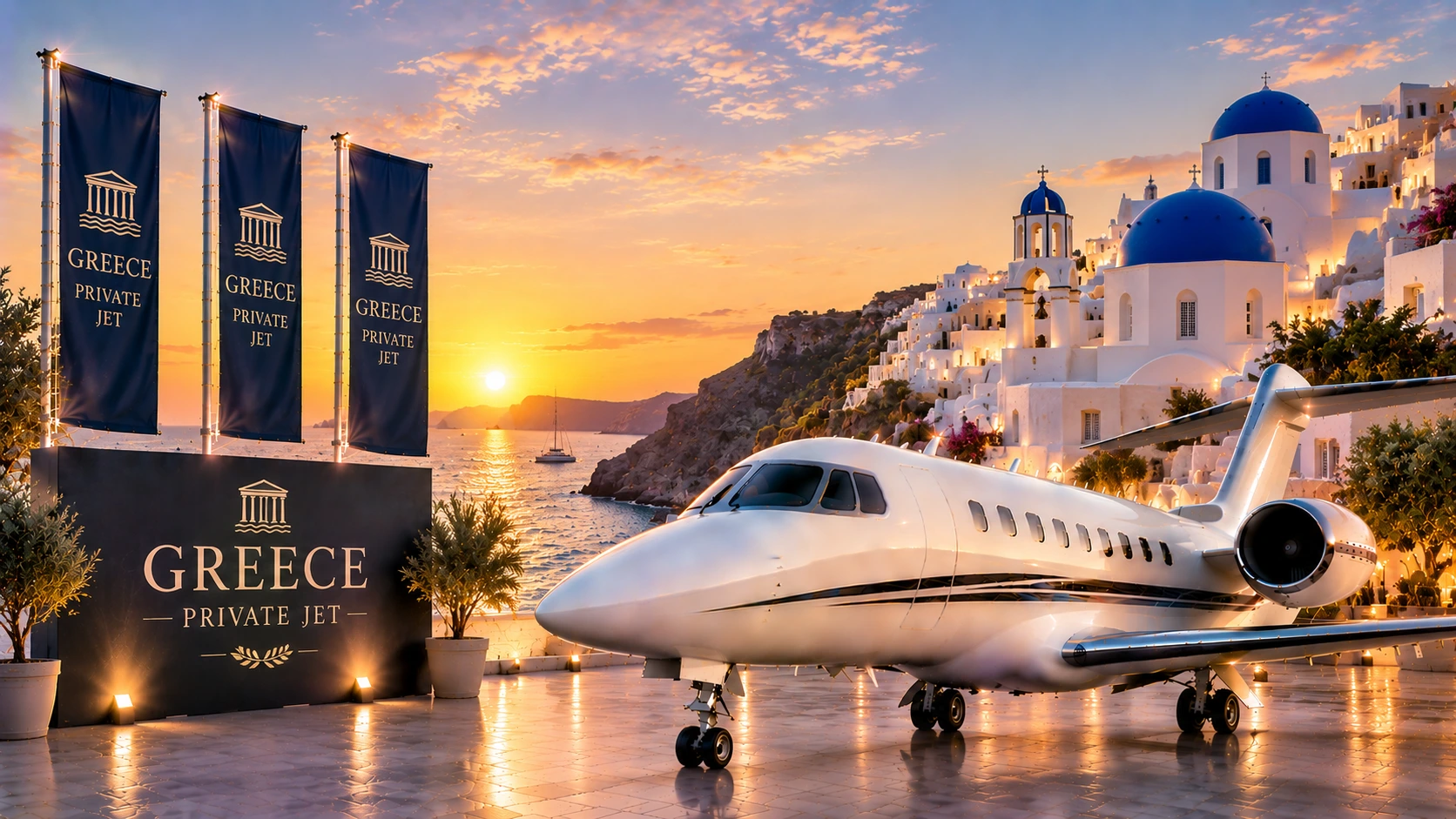
Greece is a destination where in summer operational constraints matter more than budget. Island airports are small, slots are mandatory and apron space is physically finite, so planning starts not with sourcing an aircraft but with checking whether landing on the required dates is possible at all. Below we cover mainland and island airports, the slot regime and how a flight is actually arranged.
Athens: the universal gateway
Athens International (ATH/LGAV) accepts aircraft of every class, including heavy and ultra-long-range, and has full FBO infrastructure. Per operational guidance, Athens is slot coordinated during the summer season, and long-term parking requires an additional PPR.
A quirk of the Greek system: slots can only be requested and confirmed the day before the flight, which requires the operator to hold fallback options. Athens remains the preferred point for international tech stops — a typical technical stop takes around 30 minutes.
Flight times: Athens to London is about 4–5 hours, Athens to Amsterdam around 3 hours 30 minutes to 4 hours, Athens to Moscow about 3 hours, Athens to Dubai around 4 hours 30 minutes.
Mykonos and Santorini: where freedom ends
Mykonos (JMK/LGMK) has a runway of 2,286 metres and accepts midsize and light aircraft but not heavy jets. The peak season here has stretched from the former June–September to May–October. The constraints are an evening noise curfew and an apron that fills fast with charter traffic from Athens and owner-flown aircraft.
Santorini (JTR/LGSR) is stricter: in peak season it is a Level 3 coordinated airport where every movement — private or commercial — requires an approved slot before departure. In the first three weeks of August the airport handles more than thirty commercial movements a day on top of general aviation, and the apron simply runs out of room.
The practical consequence: requests filed less than four weeks before the travel date are regularly declined outright in August. The industry recommendation for peak is to arrange the charter four to eight weeks ahead; out of season one to two is enough.
Rhodes and the other islands
Rhodes (RHO/LGRP) is the only Greek island where a 3,306-metre runway allows heavy aircraft. Mykonos, Santorini and Corfu are unsuitable for heavy jets on runway length, and this is the key filter in sourcing.
For groups needing a heavy jet to any island other than Rhodes there is one standard solution: fly into Athens and continue by helicopter, domestic flight or fast boat. That is not a compromise but ordinary itinerary practice.
The helicopter as part of the route
In Greece a helicopter transfer is infrastructure rather than luxury. Athens to Mykonos takes around 45–55 minutes, Mykonos to Santorini about 40–50 minutes. By comparison, the ferry between islands is a two- to three-hour commitment each way even on a fast catamaran.
Helicopters are used in three cases: when the aircraft cannot land on the island by class, when no slot is available, and when the programme covers several islands. Since helicopter transfers are common in Greece, they are booked a few days ahead alongside the main flight.
Seasonality and cost
The peak falls in July and August, with the high season running May to October. In peak months surcharges are added to rates that on island routes can reach 30–60% against the shoulder season.
Demand in those months exceeds available capacity: fewer aircraft are free, rates are higher, slots are scarce. From November to April the picture reverses — the islands empty and some infrastructure closes, but Athens operates year-round and stays available.
Formalities
Greece is in the EU and the Schengen area, and its civil aviation is regulated by the Hellenic Civil Aviation Authority (HCAA), so formalities on intra-Schengen flights are minimal. On first entry to or exit from the EU, customs and border control apply; onboard clearance can be requested but is not typical and remains at the discretion of the officer on duty.
When submitting a handling request, operators are advised to state tow bar availability for the specific aircraft type — it speeds up PPR processing. Tow bars for common types are available in Athens, Mykonos, Santorini, Corfu and Thessaloniki.
What to see
Athens offers antiquity: the Acropolis, the Parthenon, the Ancient Agora, the Acropolis Museum. Mykonos is known for beach clubs and nightlife, Santorini for caldera views, sunsets and dining. Corfu and Rhodes combine history with coastline, Crete offers varied landscapes and Minoan archaeology.
A typical programme combines the mainland with one or two islands. This is exactly where private aviation delivers: ferries are slow, and scheduled domestic flights in peak sell out weeks ahead.
Practical planning
The summer order of operations is the reverse of the usual. First, check whether a slot and parking can realistically be obtained on the required dates at the specific island airport. Then source the aircraft within the runway-length constraints. Only then discuss cabin comfort and layout.
If no slot exists, the working scenario is Athens plus helicopter. It is not worse and sometimes faster: the aircraft lands without restriction and the helicopter delivers straight to the villa or yacht. This option must be planned ahead, since helicopters book out just as tightly at peak.
Mainland Greece
Beyond the islands, Thessaloniki in the north is the second-largest entry point with full infrastructure, and Kalamata on the Peloponnese serves the Messinia resort area with its golf resorts. Both fields are noticeably freer than the island airports even in high season.
The mainland also offers a different trip pattern: Meteora, Delphi and the Peloponnese with its classical sites are reachable by road from Athens in two to three hours. For programmes not tied to the sea, this removes the island slot problem entirely.
Who a Greece flight suits
The first scenario is island travel at peak, when scheduled flights sell out weeks ahead and timetables do not match villa or yacht rental dates. The second is a multi-island programme, where ferries consume two to three hours per crossing.
The third is Aegean yachting routes: the aircraft delivers guests to the vessel's mooring point and a helicopter covers the last leg. The fourth is business visits to Athens out of season, when infrastructure is fully available and rates are noticeably below summer levels.
Parking on the islands
Long-term parking at island airports in peak is a problem of its own. The apron is designed for turnaround rather than storage, so after dropping passengers the aircraft is usually repositioned to Athens or the mainland and returns for the departure date.
That reposition is billed alongside the flight and on short trips can noticeably change the quote. In Athens extended parking is possible but requires a separate PPR, requested in advance together with the slot.
Frequently asked questions
Can a heavy jet reach Santorini? No: the runway does not allow it. The only Greek island for heavy jets is Rhodes, with a 3,306-metre runway.
How far ahead should I book for August? Four to eight weeks; requests later than four weeks out are regularly declined at Santorini.
What if there is no slot? Fly into Athens and continue by helicopter: 45–55 minutes to Mykonos.
How long is the flight from Moscow? About 3 hours to Athens; from Dubai around 4 hours 30 minutes, from London 4–5 hours.
Choosing an aircraft for Greece
The key filter is runway length at the destination airport. Athens and Rhodes accept every class; Mykonos, Santorini and Corfu only light and midsize. The second filter is range from the departure point, the third is passenger count.
JetHunter provides access to more than 5,000 aircraft and a catalogue of 246 models with range maps. For Greek routes, sourcing is done alongside slot and parking checks: in July and August it is these, not aircraft availability, that determine whether the flight happens on the required dates.
«On the Greek islands the budget does not decide. Santorini in August is a Level 3 coordinated airport, and a request filed later than four weeks out is simply declined. Here the slot is worth more than the aircraft.»
— Alexey Mordvintsev, CEO of JetHunter
Author: Alexey Mordvintsev, CEO of JetHunter, President of the Association of Professionals of Executive Aviation Industry (APIDA). Over 14 years in the industry.