

Frequently asked questions
What is Dassault known for and which Falcon are included in the line?
France's Dassault builds Rafale fighters and transfers military technology to the Falcon business jet. Currently in production are the Falcon 2000LXS (large-class, 7,400 km range), the three-engine 900LX, the new 6X with the widest cabin in its class (2.58 m), the flagship 8X (11,900 km), and the upcoming 10X with a range of 13,900 km. More than 2,700 Falcons have been built.
Why does the Falcon need three engines and what does this mean in practice?
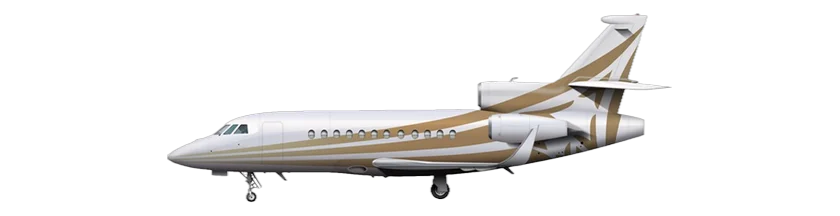
The 900LX and 8X tri-engine configuration is unique to the Dassault. Practical benefits include long-haul ocean route approval without ETOPS restrictions, peace of mind in the event of single-engine failure over mountains or water, and approaches to short, complex runways—the 8X is certified for London City with its steep glide path. Fuel consumption is also lower than many twin-engine competitors, thanks to its lightweight airframe.
How do Falcons hold their value on the secondary market?
The Falcon is aging gracefully: an eight-year-old 2000LXS sells for $18–22 million (new for $37 million), while a 900LX of the same age sells for $23–28 million. Classic 900EXs from the 2000s, at $12–16 million, are considered the best value for a three-engine intercontinental jet. The discount to the similarly sized Gulfstream is explained by the smaller fleet, but the supply of Falcons on the market is also significantly smaller.
What is the difference between Falcon and Gulfstream?
The Gulfstream scores with speed and range: the G650ER flies at M0.90 for 13,890 km, while the Falcon 8X flies at M0.85 for 11,945 km. The Falcon scores with fuel economy (the 15–20% consumes less), short-run performance, and fighter-derived digital controls. The 6X/10X cabins are wider than their Gulfstream counterparts. Roughly speaking, the Gulfstream is all about maximum performance, while the Falcon is all about flexibility and efficiency.
What country is the Dassault from, how old is the brand, and how many Falcons have been produced?
Dassault Aviation is a French company (headquartered near Paris), founded in 1929 by Marcel Dassault. In addition to Rafale fighters, it has been building Falcon business jets since 1963, with over 2,700 aircraft produced. Military technologies (fly-by-wire, aerodynamics) are being transferred to the civilian line.
Where to service Dassault Falcon in the CIS and nearby?
The Falcon network includes its own and authorized centers in Europe and the Middle East; FalconResponse provides on-site support worldwide. Operators in the region also have access to stations in Western Europe and the UAE; engines are covered by manufacturer programs.
What guarantees does Dassault provide for the new Falcon?
The factory warranty is typically 5 years or 4,000 hours for the airframe and systems. The Falcon Care program provides predictable hourly maintenance, and engines are covered by Pratt & Whitney/Honeywell programs. A 24/7 engineering support center is available.
What is the waiting period for the new Dassault Falcon?
The Falcon 6X and 8X are delivered in approximately 1.5 to 2 years, while the newest 10X will begin deliveries in 2027 and is already accepting orders. Faster acquisition is possible on the Falcon used market, where supplies are consistently low.
How much do Dassault and Falcon aircraft cost: price guide?
Falcon 2000LXS — $36 million new (secondary from $10–22 million), Falcon 6X — $53 million, Falcon 8X — $64 million, future 10X — $75 million. Three-engine 900LX on the secondary market — $16–30 million. Falcon are aging gracefully and holding their value.
What Dassault models are available and how to choose the right one?
The lineup includes the large Falcon 2000LXS, wide-cabin 6X and 8X, three-engine 900LX, and the future flagship 10X. Three engines (900LX, 8X) provide unlimited ocean routes and short-run approaches; for maximum cabin space and fuel efficiency, choose the 6X/10X.

