Short
Business aviation is unscheduled travel, where you, not the airline, determine the route, time, and passenger composition. The practical benefit is time savings: a flight that takes 16 hours with two transfers on scheduled airlines, on a private jet, takes seven hours direct. The market consists of three participants: operators (who own the aircraft), brokers (who provide access to hundreds of operators at once), and FBOs (free booking offices) – separate business aviation terminals at airports.
Business aviation is the use of general-aviation aircraft for a business purpose. As the National Business Aviation Association (NBAA) defines it, this is the use of any general-aviation aircraft for a business purpose, and the US Federal Aviation Administration defines general aviation as all flights not conducted by the military or scheduled airlines.
Put simply, it is air travel where the route, timing and passenger mix are set by the customer, not by a carrier's schedule. That distinguishes it from scheduled airlines and from military aviation, and it defines the whole economics of the sector: flexibility rather than volume.
What business aviation includes
Contrary to the 'billionaire's private jet' image, business aviation covers a wide spectrum of operators and aircraft types. Per NBAA, a 'business aircraft' is a fixed-wing turbine aircraft plus piston-twin general-aviation aircraft flown for business or corporate operations; about 3% are flown by Fortune 500 companies, and the other 97% are governments, schools and universities, farms, foundations, charities and businesses of every size.
Aircraft types vary widely — from piston aircraft not much bigger than a car to jets seating more than a dozen and capable of non-stop international flights. Yet, as NBAA notes, the vast majority of business aircraft seat about six passengers in a cabin roughly the size of a large SUV and fly an average stage length of under 1,000 miles.
Aircraft classes
Within the business fleet, aircraft are grouped by range and capacity. The rough ladder: turboprops, very light jets (VLJ), light, midsize, super-midsize, heavy, ultra-long-range and business airliners built on mainline platforms. Class defines the key parameters — non-stop range and seat count.
Each class has recognisable representatives: in the light segment the Embraer Phenom 300EV, in midsize the Cessna Citation Latitude, in super-midsize the Embraer Praetor 600E, and in ultra-long-range the Bombardier Global 7500 and Gulfstream G800. Class answers the central sourcing question: will the aircraft reach the required distance non-stop and carry the needed passengers. Differences are material: aircraft in the same class can vary in range by 1,500–2,000 km, which directly determines whether a technical stop is needed.
Who operates business aircraft
The industry structure is far from the stereotype. Per SKYbrary, about 75% of companies operating business aircraft fly a single aircraft, another 12% fly two, and only 13% run fleets of three or more. Most operators are small and mid-sized companies.
Passenger breakdown is telling: per NBAA, 86% of business-aircraft passengers are marketing and sales staff, technical experts and customers, and only 14% are top company managers. The aircraft is used as a working tool, not an executive perk.
Why companies use business aviation
The core value is access and time. Business aircraft serve many times more airports than scheduled airlines, including small fields near the trip's endpoint with no airline service. That reaches places the airline network does not fly to and saves hours on connections.
Business aviation does not fully replace scheduled flights: companies owning an aircraft analyse each trip and often still spend significantly on airline tickets. The tool is chosen for the mission, not by default.

Scale of the industry
Business aviation is a visible part of the global economy. Industry estimates of the market for 2025–2026 sit in the region of $50–65 billion a year with growth forecast; the business-aviation services market was valued at about $59.6 billion in 2025 with further growth projected.
The new-aircraft market is growing too. Per the General Aviation Manufacturers Association (GAMA), business-jet deliveries rose 11.8% in 2025 to 854 aircraft, and the combined value of all aircraft delivered reached a record $35.7 billion.
The US remains the largest market: most of the world's business fleet is operated, serviced and maintained there, and per NBAA the industry employs around one million people. Business aviation is not a niche — it is a full segment of the transport system.
How business aviation differs from scheduled airlines
The difference is not only comfort. A scheduled airline runs a fixed timetable between major hubs, while a business aircraft flies when and where the customer needs. This flips the logic of the trip: the flight adapts to the passenger, not the other way round.
The second key difference is the airport network. Scheduled service is tied to a limited number of large airports, whereas business aviation uses many times more fields, including small aerodromes near the trip's endpoint. That removes connections, long ground transfers and dependence on someone else's schedule.
The third is privacy and predictable timing. Dedicated terminals (FBOs), fast-track procedures and no shared queues mean the path from the airport approach to take-off is measured in minutes, not hours. For a business passenger that converts into working time.
Ways to access a business aircraft
There are several ways to use business aviation, and the choice depends on how many hours a year the customer flies. Full ownership makes sense at high utilisation: the owner carries all fixed and variable costs but gains full control of the aircraft.
Fractional ownership shares the aircraft and part of the fixed costs among several co-owners. Jet cards give a fixed hourly rate and predictability without ownership. On-demand charter means paying only for a specific flight — best for those who fly irregularly.
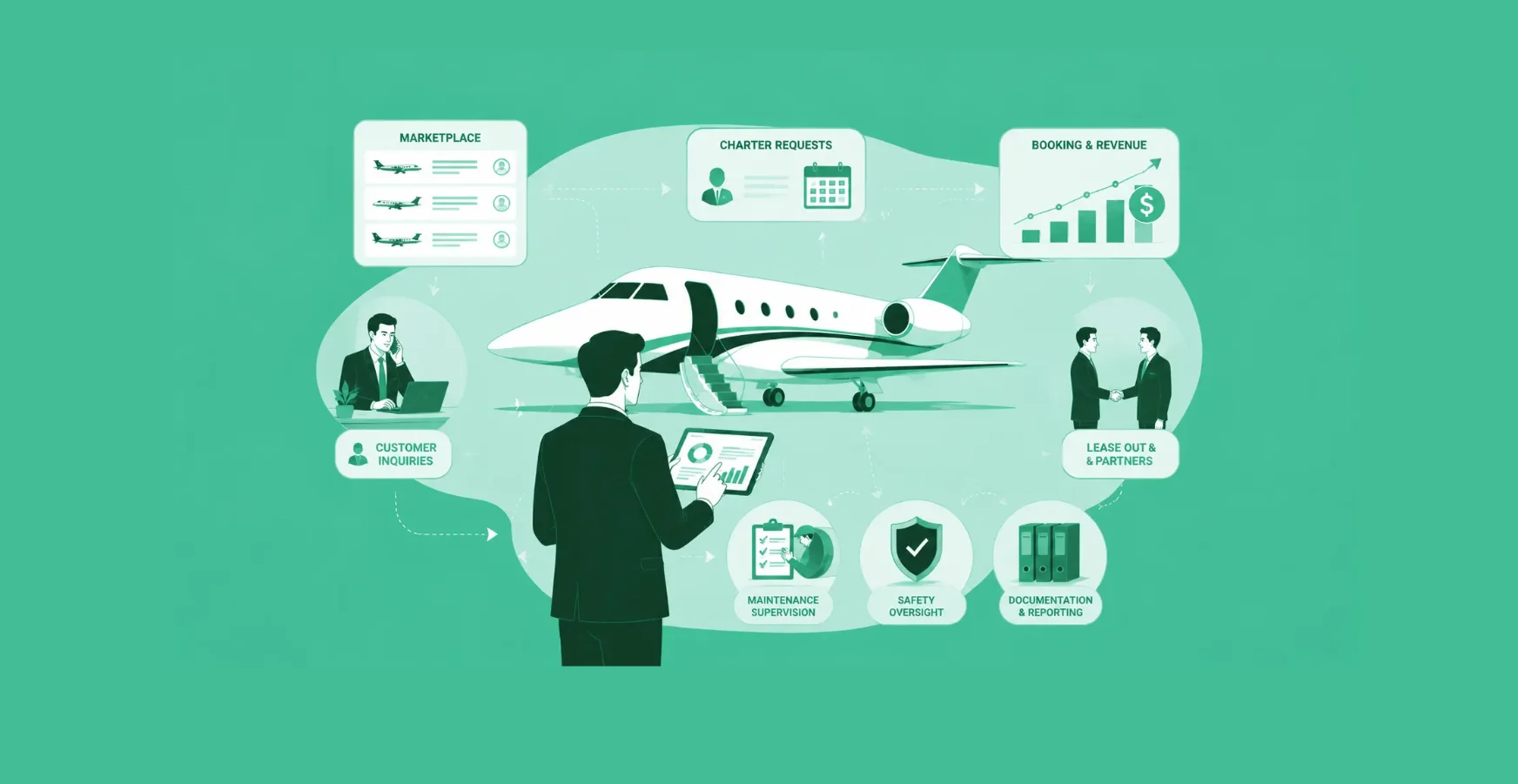
A separate category is aircraft management: the owner keeps title but hands operation, maintenance, crew and compliance to a management company. Often the aircraft is partly chartered out, offsetting the owner's costs.
Safety
Business aviation is a strictly regulated segment. Commercial operators are certified (in the US, under Part 135), and beyond formal requirements the industry uses independent safety audits: ARGUS, Wyvern and the international IS-BAO standard. These ratings let a customer assess an operator before flying.
The regulator also publishes open data: for example, the FAA maintains a public list of legal Part 135 certificate holders, which lets you verify an operator and a specific aircraft by tail number. This guards against illegal charter.
Aviation as a whole remains the safest mode of transport. Per the EASA Annual Safety Review 2025, Europe operates millions of flights a year at an extremely low accident rate — and the same standards extend to business aviation.

What business aircraft are used for
There are many uses, far beyond carrying executives. They include moving teams to sites and clients, urgent cargo and spares, air ambulance, government and special missions, and crew training. The same aircraft type can serve different tasks depending on configuration.
This flexibility follows directly from the nature of business aviation: because the customer sets route and schedule, the aircraft adapts to a specific business task. That is why the sector has so many small single-aircraft operators serving their own needs rather than large fleets.
Infrastructure: FBOs and the airport network
Business aviation relies on a separate infrastructure — a network of FBOs (fixed-base operators), private terminals with lounges, fuel, ground handling and fast-track procedures. It is the FBOs that deliver the fast 'curb to aircraft' path without shared queues.
The key advantage is airport reach. Business aircraft use many times more fields than scheduled airlines, including small aerodromes near the trip's endpoint. That removes connections and long ground transfers, turning destinations unreachable by a direct flight into achievable ones.
How business aviation is regulated
Rules depend on the nature of the flights. In the US, an owner's private flights operate under FAR Part 91, while commercial on-demand charter operates under Part 135, which sets strict safety, maintenance and operational standards for on-demand carriers.
In Europe, EASA approval plays the equivalent role. Knowing which rules a flight runs under matters to the customer too: it drives safety standards and the split of responsibility between operator and broker.
Industry trends
Business aviation is changing fast. Interest in sustainable aviation fuel (SAF) is growing and it is gradually appearing at major hubs; fractional and jet-card programmes are lowering the barrier to entry; and on the horizon are electric and hybrid propulsion and supersonic projects.
The market remains tied to economics: demand is sensitive to business activity and the number of wealthy clients, and operators renew fleets by replacing ageing aircraft. For the customer, that means a widening choice of aircraft and ways to access business aviation.
How JetHunter works in business aviation
JetHunter is an international business-aviation brokerage: aircraft sourcing and purchase, charter flights, empty legs and fleet management. It provides access to more than 5,000 aircraft worldwide and maintains an open catalogue of 246 models with specifications, range maps and operating costs.
That reach makes it possible to handle the task from setting the aircraft class for a route to running the deal or arranging the charter — accounting for which rules and safety level a given flight is performed under.
«Business aviation is a tool, not a luxury. Eight in ten passengers fly for work, and that is exactly how the aircraft should be treated.»
— Alexey Mordvintsev, CEO of JetHunter
Author: Alexey Mordvintsev, CEO of JetHunter, President of the Association of Professionals of Executive Aviation Industry (APIDA). Over 14 years in the industry.