



Frequently asked questions
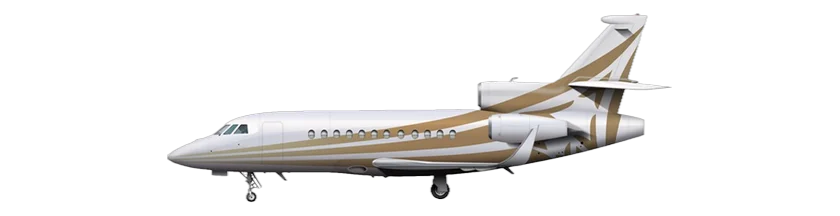
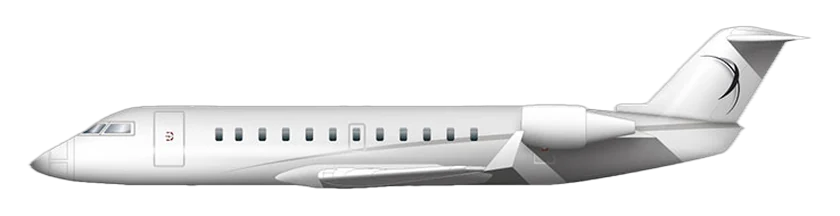
Falcon 900EX (OE-IMI): what kind of aircraft is it and what is its cabin layout?
The Falcon 900EX (OE-IMI) is a 2001 aircraft. Cabin layout — 14 seats. The type has a range of about 8,340 km at a 890 km/h cruise and is best on 2–4-hour legs. There is no flight attendant or hot meal service. The baggage compartment is accessible in flight. Send us a request — we'll prepare options, calculate running costs and analyse the best fit for your task.
Where is the Falcon 900EX (OE-IMI) based and how much does it cost to charter?
Based in Vienna, Austria. From its home base it typically flies legs such as Vienna–Munich · Vienna–London · Vienna–Dubai. Positioning from the home region is faster and cheaper; departures from another city add a ferry leg. Send us a request — we'll prepare options, calculate running costs and analyse the best fit for your task.
What is Dassault known for and which Falcons are in the range?
France's Dassault builds the Rafale fighter and carries military technology into the Falcon business jets. In production today: the Falcon 2000LXS (large class, 7,400 km), the tri-jet 900LX, the new 6X with the widest cabin in class (2.58 m), the flagship 8X (11,900 km) and the 10X, nearing delivery, with 13,900 km. In all, more than 2,700 Falcons have been built. Send us a request — we'll prepare options, calculate running costs and analyse the best fit for your task.
Why does the Falcon have three engines and what does it give in practice?
The tri-jet layout of the 900LX and 8X is Dassault's signature. The practical benefit: clearance for long ocean routes without ETOPS limits, peace of mind if one engine fails over mountains or water, and approaches to short, demanding runways — the 8X is certified for London City with its steep glideslope. Fuel burn is meanwhile lower than many twin rivals, thanks to a light airframe. Send us a request — we'll prepare options, calculate running costs and analyse the best fit for your task.
How well do Falcons hold value on the pre-owned market?
Falcons age gracefully: an eight-year-old 2000LXS sells for $18–22M (new $37M), a 900LX of the same age $23–28M. Classic 2000s 900EX at $12–16M are considered the best price for a tri-jet intercontinental jet. The discount to a same-size Gulfstream reflects a smaller fleet, but Falcon supply on the market is also notably shorter. Send us a request — we'll prepare options, calculate running costs and analyse the best fit for your task.
How does the Falcon differ from Gulfstream?
Gulfstream leads on speed and range: the G650ER flies M0.90 over 13,890 km, while the Falcon 8X does M0.85 over 11,945 km. The Falcon answers with economy (15–20% less burn), short-field operation and digital control honed on fighters. The 6X/10X cabins are wider than Gulfstream equivalents. Roughly: Gulfstream is about maximum performance, Falcon about flexibility and efficiency. Send us a request — we'll prepare options, calculate running costs and analyse the best fit for your task.
What routes and tasks suit ultra-large jets?
A class for those who need a maximum cabin without long-range prices: 8–10-hour flights like London–Dubai, Paris–Delhi, Dubai–Singapore. Three cabin zones allow a meeting, a meal and sleep at once. Typical tasks — carrying delegations, family travel in large groups, and government and corporate flights with 10–14 passengers. Send us a request — we'll prepare options, calculate running costs and analyse the best fit for your task.
What range and how many passengers do ultra-large jets have?
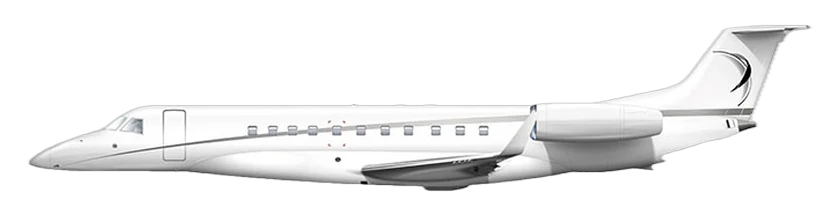
Capacity is 10–16 seats: the Legacy 600/650 take 13–14 passengers, the Challenger 850 up to 14–16. Range: Challenger 850 5,200 km, Legacy 600 6,000 km, Legacy 650 7,200 km, Gulfstream G450 8,060 km, the tri-jet Falcon 900LX 8,800 km. The Legacy's holds of up to 6.8 m³ are the most capacious in the segment short of long-range jets. Send us a request — we'll prepare options, calculate running costs and analyse the best fit for your task.
How does a ultra-large jet differ from neighbouring classes?
To the large class it adds a third cabin zone and up to 16 seats — but a notable part of the segment (Legacy, Challenger 850) is built on regional airliners, so the aircraft are heavier and climb more slowly. The long-range class (Global, Gulfstream G550+) gives 9,600–14,800 km and fresh airframes, but costs twice as much to buy. Here you get the maximum cabin for sensible money. Send us a request — we'll prepare options, calculate running costs and analyse the best fit for your task.
How much does an hour on a ultra-large jet cost?
Rates are $8,000–12,000 per hour. Guides: London–Dubai on a Legacy 650 $55–75K, Geneva–Dubai on a Challenger 850 $40–55K. Per passenger at full load that is $300–500 an hour per person — for groups of 10+ it beats two light jets on both cost and logistics: the whole delegation flies together. Send us a request — we'll prepare options, calculate running costs and analyse the best fit for your task.
How far in advance should a flight be booked?
The standard is 24–48 hours before departure: that is enough to confirm the aircraft, crew and slots. For regular clients we arrange a domestic flight from 4–6 hours. International routes need 48–72 hours: overflight permits for some countries take 3–5 working days. On peak dates — Christmas, summer holidays, major forums — aircraft are booked out 2–3 weeks ahead, so plan early.
What are empty legs and how much can you save on them?
An empty leg is the ferry of an empty aircraft to its next job or home to base. Such segments sell at a 30–75% discount to the usual price: a flight that would cost $25K can come to $8–12K. The limits: the date and route are fixed to the aircraft's schedule, and if the main booking is cancelled the flight may shift. We publish current empty legs weekly — watch the listings.